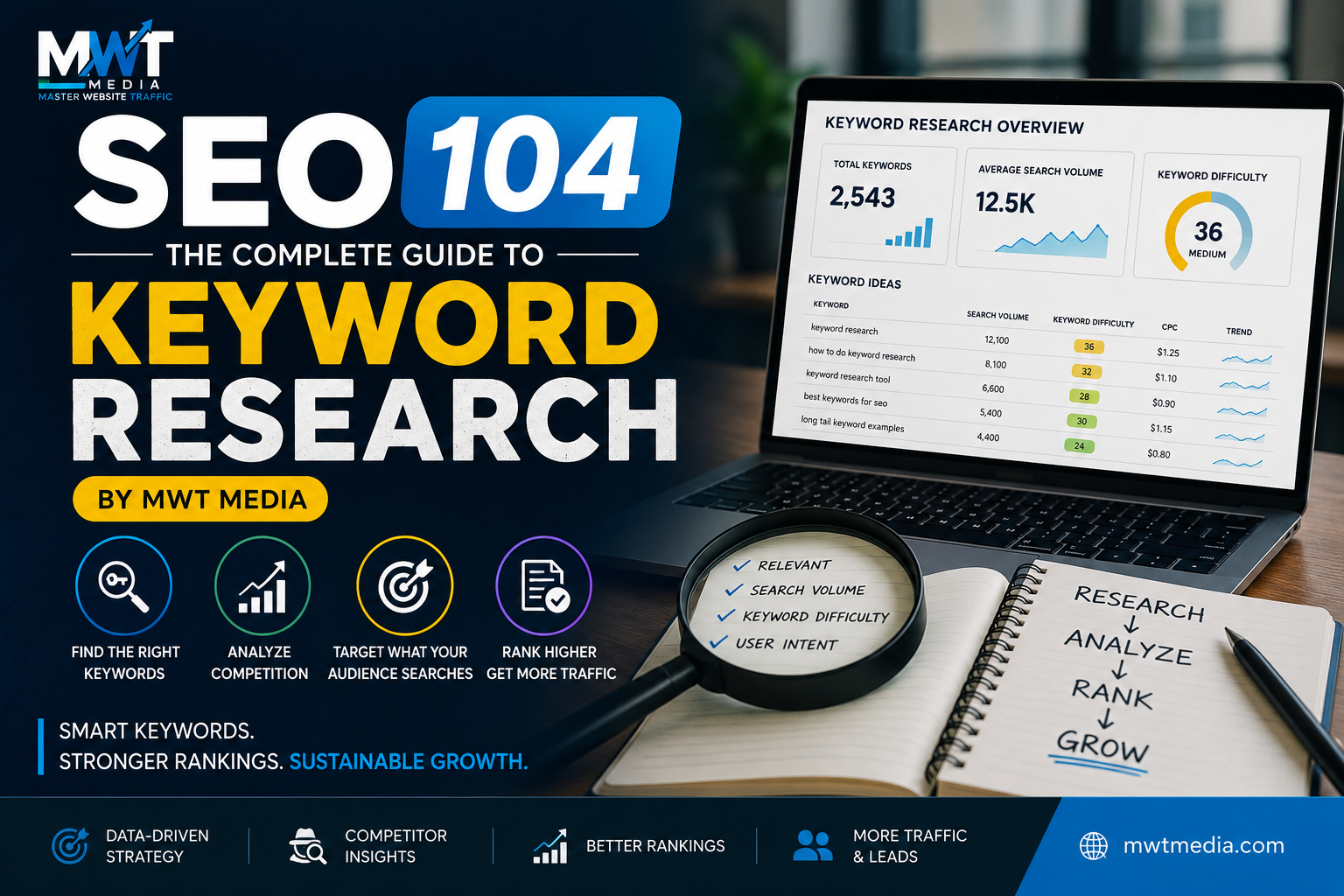
This is the fourth installment in our SEO series. If you missed the earlier posts, catch up here: SEO 101 (SEO-friendly writing), SEO 102 (structured data), and SEO 103 (technical SEO). This time, we’re digging into keyword research — arguably the single most consequential step in any content or SEO strategy, because it determines what you’re even trying to rank for.
Why Keyword Research Comes First
Every other SEO tactic — on-page optimization, internal linking, technical fixes — only pays off if you’re targeting the right terms. Rank #1 for a phrase nobody searches, and it won’t move the needle. Rank #5 for a phrase with real demand and buying intent, and it can outperform a dozen “vanity” rankings combined. Keyword research is how you find that second category of term before you invest time writing content around it.
The 2026 Search Landscape: Why Keyword Choice Matters More Than Ever
Keyword research isn’t happening in the same environment it did even two years ago. Google’s AI Overviews now surface on roughly half of tracked queries, and independent studies put the resulting hit to organic click-through rates in the 40–60% range on informational searches once an AI summary appears. Zero-click behavior — where a searcher gets their answer without visiting any website — is estimated to account for well over half of all Google searches today.
That sounds like bad news, and for generic, top-of-funnel queries it often is. But the data reveals a more useful pattern:
- Broad, purely definitional queries get absorbed. If a searcher can get a complete answer in two sentences, Google increasingly gives it to them directly, and traffic to informational head terms has taken the steepest hit.
- Specific, commercial, and long-tail queries hold up much better. Searches with clear buying or navigational intent still send meaningful traffic, because AI summaries alone can’t complete the transaction.
- Being cited inside an AI Overview is now its own win. Several industry studies have found that brands and pages cited within an AI Overview see meaningfully higher click-through rates than uncited competitors on the same query — the citation itself acts as a trust signal.
The practical implication for keyword research: volume alone is a worse predictor of value than it used to be. A keyword needs to be evaluated not just on “how many people search this” but “will this query still send a click once Google (or an AI engine) has tried to answer it directly.” This is one of the reasons long-tail, intent-rich, and commercially specific keywords deserve more weight in your strategy than they did a few years ago — a theme we’ll come back to below.
Understanding Search Intent
Before chasing search volume, you need to understand why someone is typing a given phrase into Google. Search intent generally falls into four buckets:
- Informational — the searcher wants to learn something (“how does keyword research work”). These searches are usually top-of-funnel.
- Navigational — the searcher already knows where they want to go (“Ahrefs login“). Hard to compete for unless it’s your own brand.
- Commercial investigation — the searcher is comparing options before buying (“best keyword research tools 2026”).
- Transactional — the searcher is ready to act now (“buy Ahrefs subscription”).
Matching content format to intent matters as much as matching the keyword itself. An informational query deserves a blog post or guide; a transactional query deserves a product or landing page. Publishing the wrong format for the intent is one of the most common reasons a page fails to rank even with decent on-page SEO.
Core Keyword Metrics to Understand
When evaluating a keyword, four numbers matter most:
- Search volume — how many people search the term monthly. Useful for gauging opportunity size, but volume alone is a vanity metric.
- Keyword difficulty (KD) — a relative estimate of how hard it is to rank, usually based on the backlink profile and authority of currently ranking pages.
- Cost-per-click (CPC) — what advertisers pay for the term in paid search. A rough proxy for commercial value, even if you’re not running ads.
- Click-through rate (CTR) potential — some queries get “zero-clicked” because Google answers them directly in a featured snippet or AI overview. High volume with low CTR potential can be a trap.
The goal isn’t to maximize any single metric — it’s to find the intersection of real demand, achievable difficulty, and commercial or strategic relevance to your business.
Building Your Keyword List
Start with seed keywords. These are the broad, obvious terms that describe your product, service, or content topic. If you sell running shoes, “running shoes” is a seed keyword.
Expand with keyword research tools. Tools like Ahrefs, Semrush, Google Keyword Planner, and Ubersuggest take a seed keyword and surface related terms, questions, and long-tail variations, along with volume and difficulty data.
Mine your competitors. Running a competitor’s top-ranking domain through a keyword tool reveals which terms are already sending them traffic — often uncovering keywords you hadn’t thought to target.
Use Google itself. Autocomplete suggestions, the “People also ask” box, and related searches at the bottom of the results page are free, real-time signals of how people phrase their queries.
Don’t ignore long-tail keywords. Short, high-volume “head” terms are usually the most competitive. Longer, more specific phrases typically have lower volume individually but convert better and are far easier to rank for — and collectively, a strong set of long-tail pages can out-earn a single head-term page. This isn’t just theory; it’s borne out in keyword-database research at scale:
- Long-tail queries are estimated to make up somewhere between 70% and 92% of all search queries, depending on how “long-tail” is defined and which dataset is used — with a large share of all searchable keywords getting 10 or fewer monthly searches each.
- Conversion rate tends to climb with query length. Data from paid-search studies shows conversion rates rising sharply from single-word queries up through five-, six-, and seven-word phrases before leveling off, as longer queries signal more specific, decision-stage intent.
- Pages built around long-tail terms have been shown to climb further in average ranking position than pages targeting short, generic head terms, likely because there’s simply less competition to out-rank.
None of this means you should abandon head terms entirely — they still matter for brand visibility and topical authority — but a keyword strategy weighted too heavily toward broad, one- or two-word phrases is fighting the hardest possible battle for a shrinking share of clicks. A blended approach — a handful of head terms for authority, backed by a much larger set of long-tail pages for actual traffic and conversions — tends to perform best in practice.
Organizing Keywords Into Clusters
Once you have a sizable list, group related keywords into topic clusters rather than targeting each one with a separate, thin page. For example, “keyword research tools,” “free keyword research tools,” and “best keyword research tools for beginners” likely belong on the same comprehensive page rather than three competing ones. Clustering:
- Prevents keyword cannibalization (multiple pages on your own site competing against each other)
- Signals topical authority to search engines
- Makes it easier to build a logical site structure and internal linking plan
Balancing Volume, Difficulty, and Relevance
A common mistake is chasing the highest-volume keyword in a niche regardless of feasibility. A newer or smaller site is usually better served targeting a portfolio of lower-difficulty, moderate-volume terms it can realistically rank for, then using the traffic and authority gained to work up to more competitive terms over time. Prioritize keywords where:
- Search intent matches content you can genuinely deliver well
- Difficulty is achievable given your site’s current authority
- The term is closely relevant to your actual product or expertise — traffic that doesn’t convert or engage isn’t worth chasing
Keyword Research Is Ongoing, Not One-and-Done
Search behavior shifts — new products launch, language evolves, algorithms change what “wins” a SERP. Revisit your keyword strategy on a regular cadence (quarterly is a reasonable default) to catch new opportunities, retire underperforming targets, and keep your content aligned with how people are actually searching today.
Get these fundamentals right, and every other SEO tactic in this series has something worth optimizing.