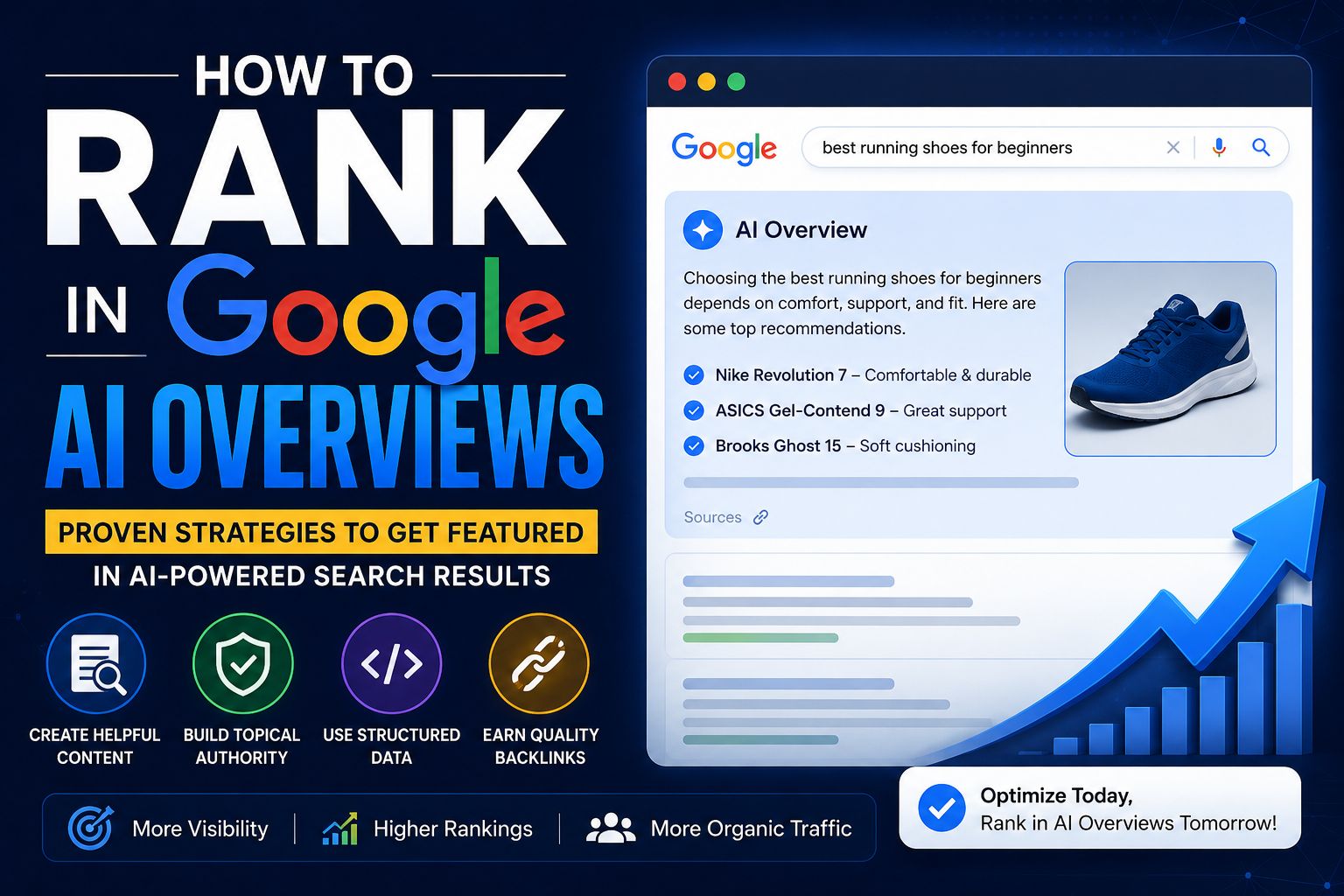
Search results don’t look the way they used to. On a growing share of queries, the first thing you see isn’t a list of blue links — it’s a short, AI-generated summary sitting above them, with citation chips linking out to the pages it pulled from. Learning how to rank in Google AI Overviews has become one of the most important skills in SEO this year, because being cited (or being ignored) can now shape a huge share of your organic visibility.
This guide walks through what AI Overviews actually are, how the system chooses which pages to cite, and the concrete steps you can take to improve your chances of showing up.
What Are Google AI Overviews?
AI Overviews are Google’s AI-generated summaries that appear at the top of results for many informational queries. Instead of only showing traditional listings, Google’s generative layer (powered by Gemini) synthesizes an answer by pulling short, factual passages from a handful of trusted, already-ranking pages, then presents them with links back to the original sources.
An important thing to understand before you try how to rank in Google AI Overviews: this feature doesn’t use a separate crawler or a separate ranking system. It draws from the same web index that powers classic search. AI Overviews doesn’t invent new winners out of nowhere — it elevates passages from pages that have already earned organic visibility. That means traditional SEO isn’t obsolete; it’s the entry ticket. Ranking on page one, though, is necessary but no longer sufficient on its own.
How the System Chooses What to Cite
This is the part beginners most often get wrong. Ranking well organically doesn’t guarantee a citation, because the unit of optimization has shifted from the page to the passage. Google’s generative layer picks specific paragraphs, not entire pages. A page sitting at position four with one especially clear, self-contained answer can win the citation over the page at position one that buries its answer in a long, unfocused introduction.
So when people ask how to rank in Google AI Overviews, the real question is closer to: how do I write the single clearest, most credible passage that answers this specific sub-question?
Core Strategies for Ranking in AI Overviews
1. Write in Extractable Passages
The single most effective tactic is structuring content so each key question is answered immediately and directly — ideally within 40 to 90 words, in plain declarative language, right under a heading phrased as that question. Avoid long throat-clearing introductions before you get to the answer.
2. Build Real E-E-A-T Signals
Google continues to weigh Experience, Expertise, Authoritativeness, and Trustworthiness heavily when deciding what’s reliable enough to cite. Practical ways to strengthen this:
- Add real case studies, statistics, and first-hand examples
- Include detailed author bios and credentials
- Earn mentions and backlinks from reputable, relevant sites
- Keep business information, contact details, and policies accurate and transparent
Generic, unsourced content rarely gets pulled into an AI-generated answer — Google’s systems are specifically trying to avoid citing anything that looks thin or unverified.
3. Use Schema Markup
Structured data isn’t strictly required, but it functions as a strong eligibility signal. Pages with valid Article, FAQPage, HowTo, Product, or Organization schema tend to appear in citation chips at a noticeably higher rate than pages without it, since schema makes it easier for Google’s systems to confirm what a page is actually about.
4. Cite Original, Authoritative Sources Yourself
If you want your content to be viewed as trustworthy enough to cite, model that behavior. Link to primary data sources rather than blogs that paraphrased them, and reference recent, reputable organizations (government bodies, research institutions, established industry reports) instead of vague, unattributed claims. AI systems are built to downweight statements that can’t be backed up.
5. Prioritize Topical Authority, Not Just One Page
Google’s generative layer favors sources that demonstrate depth across a subject, not just a single well-optimized article. Building out a cluster of well-linked, related content around your core topic signals that your site is a genuine authority — not a one-off attempt to game a single query.
6. Nail the Technical Fundamentals
None of the above matters if your page isn’t fast, secure, and easy to use. Core requirements include:
- HTTPS and solid site security
- Fast page load speed and strong Core Web Vitals
- Mobile-responsive design
- Clean navigation and clear site structure
7. Keep Content Fresh
AI Overviews tend to favor fresh, up-to-date information, especially on topics where facts, prices, or statistics change over time. Revisiting and updating older content — not just publishing new pages — is a meaningful part of staying eligible for citations.
8. Match Content to a Single Clear Intent
Each page should fulfill one clear search intent rather than trying to cover too much ground at once. Focused pages are easier for Google’s systems to match confidently to a specific query, which improves both traditional rankings and the odds of being pulled into an Overview.
A Quick Beginner Checklist
- Identify the real sub-questions inside your target topic, not just the head keyword.
- Answer each sub-question in a short, self-contained passage directly under its heading.
- Back up claims with data, examples, and credible external sources.
- Add author bios and visible expertise signals.
- Apply accurate schema markup where it fits.
- Fix technical basics: speed, mobile experience, HTTPS, crawlability.
- Build supporting content around the topic to establish authority, not just a single page.
- Refresh key pages regularly so information stays current.
What Doesn’t Change
It’s worth repeating: how to rank in Google AI Overviews is still fundamentally rooted in classic SEO. Google has stated that AI Overviews draw from the same helpful, reliable, people-first content standards used across regular Search. There’s no secret shortcut or separate algorithm to reverse-engineer. What’s different is the bar for how that content needs to be structured and substantiated — clear, extractable, well-sourced, and genuinely useful.
Final Thoughts
Ranking in AI Overviews isn’t about chasing a new trick every month. It’s about combining solid technical SEO with content that answers real questions clearly, backs itself up with credible evidence, and demonstrates that a real expert stands behind it. Get those fundamentals right, structure your key answers as clean, citable passages, and you’ll be well positioned as AI Overviews continue to expand across more of Google’s search results.

Daniel
Daniel is an SEO & Content Writer at MWT Media, specialising in crafting data-driven content that ranks. With a deep understanding of search engine optimisation, keyword strategy, and audience engagement. He creates compelling articles, blog posts, and web copy that not only attract organic traffic but convert readers into customers. At MWT Media, Daniel plays a key role in developing content strategies that align with client goals — from on-page SEO optimisation to high-quality guest posting campaigns.