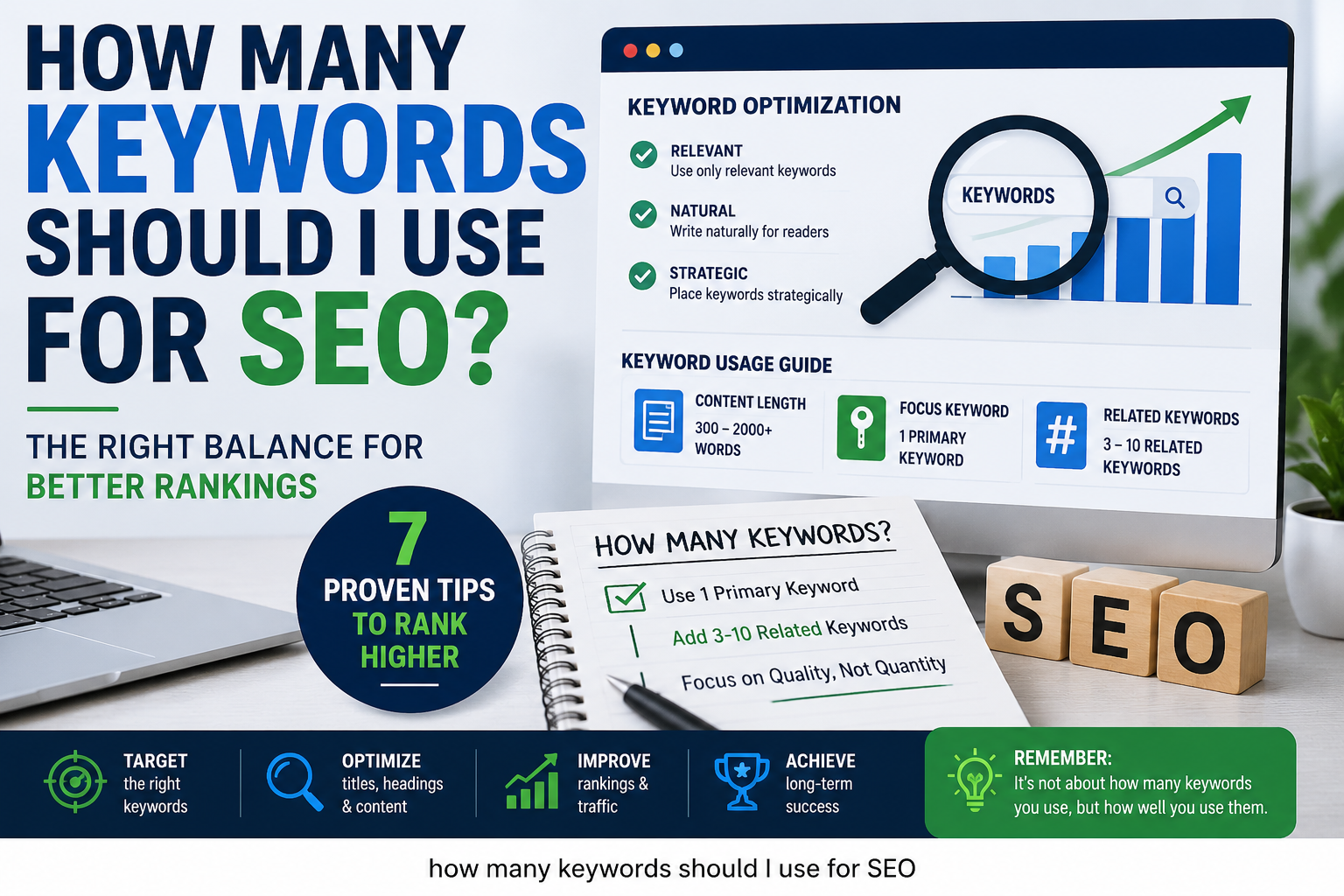
If you’ve ever sat down to optimize a webpage and asked yourself, “how many keywords should I use for SEO?” — you’re not alone. It’s one of the most common questions in content marketing, and also one of the most misunderstood. Too few keywords, and search engines may struggle to understand what your page is about. Too many, and you risk keyword stuffing, which can hurt both readability and rankings.
The short answer: there’s no fixed number. But there is a smart, proven framework — and this guide walks you through exactly how to apply it, using primary, secondary, and semantic keywords, correct placement, healthy density, and the search intent and topical authority principles that Google’s algorithms (and AI-powered search features) reward in 2026.
Quick Answer: How Many Keywords Should You Use on a Page?
For most standard blog posts or landing pages (1,000–2,000 words), a good structure looks like this:
- 1 primary keyword — the main topic of the page
- 3–5 secondary keywords — closely related terms and variations
- 8–15 semantic/LSI keywords — supporting terms that add topical depth
Rather than counting exact repetitions, modern SEO focuses on comprehensive topic coverage. A page that thoroughly answers a searcher’s question, using natural language and related terminology, will almost always outperform a page that repeats one exact phrase as many times as possible.
What Counts as a “Keyword” in Modern SEO?
Before diving into numbers, it helps to clarify what a keyword actually is in 2026. It’s no longer just a single word or exact phrase you repeat — it’s a concept your content needs to fully address. Search engines now interpret meaning, context, and related entities, not just literal text matches.
This is why SEO professionals now think in terms of keyword clusters: groups of related terms and questions that share the same search intent and can be answered by a single, well-structured page.
Primary vs. Secondary vs. Semantic Keywords
Understanding the difference between these three keyword types is essential to answering “how many keywords should I use for SEO” correctly.
| Keyword Type | Definition | Example (Topic: Running Shoes) | Typical Usage |
|---|---|---|---|
| Primary Keyword | The main term your page is built around; used once as the core focus | “best running shoes for beginners” | 1 per page, in title, H1, URL, intro, conclusion |
| Secondary Keywords | Close variations, synonyms, or subtopics of the primary keyword | “running shoes for new runners,” “beginner running shoe guide” | 3–5 per page, in H2s and body copy |
| Semantic/LSI Keywords | Contextually related terms search engines expect to see in expert content | “cushioning,” “arch support,” “pronation,” “trail running,” “shoe fit” | 8–15+ per page, woven naturally throughout |
Real-world example: If you’re writing a page targeting “best running shoes for beginners,” a well-optimized article wouldn’t just repeat that phrase over and over. Instead, it would naturally include secondary phrases like “beginner-friendly running shoes” or “running shoe guide for new runners,” alongside semantic terms like cushioning, arch support, breathability, and pronation — the exact vocabulary a genuine running expert would use.
Keyword Placement: Where Keywords Actually Matter
Placement carries more SEO weight than raw frequency. Here’s where your primary keyword should appear:
- Title Tag / H1 — as close to the front as possible
- URL Slug — short and keyword-focused
- Meta Description — naturally, within the first 155 characters
- First 100 Words — mentioned early to confirm topical relevance
- At Least One H2 Subheading — reinforces topic structure for both readers and search engines
- Image Alt Text — describes the image while including relevant keywords
- Body Content — naturally distributed, not clustered in one paragraph
- Conclusion — restated once to reinforce the page’s core topic
Secondary and semantic keywords should be spread throughout your H2s, H3s, and body paragraphs — wherever they fit naturally into the explanation.
Keyword Density: What’s a Healthy Range?
Once you’ve settled the question of ”how many keywords should I use for SEO” purposes, the next question is usually density — how often your primary keyword appears relative to your total word count. While density is no longer a hard ranking rule, it remains a useful editorial diagnostic.
| Word Count | Recommended Density | Approx. Primary Keyword Mentions |
|---|---|---|
| 500 words | 1–2% | 5–10 mentions |
| 1,000 words | 1–2% | 10–20 mentions |
| 2,000 words | 0.5–1.5% | 10–30 mentions |
| 3,000 words | 0.5–1% | 15–30 mentions |
Note that as content gets longer, density percentages naturally decrease — you don’t need to keep repeating the exact phrase at the same rate throughout a 3,000-word guide.
Rule of thumb: If reading your content out loud sounds repetitive or unnatural, you’ve used the keyword too many times. Prioritize clarity and flow over hitting an exact percentage.
Keyword Stuffing: What It Is and Why It Hurts Rankings
Once you know ”how many keywords should I use for SEO” in a healthy sense, it’s worth understanding the opposite failure mode: keyword stuffing. This is the practice of overloading a page with a keyword or phrase in an unnatural, excessive way, purely to try to manipulate rankings. It’s one of the oldest SEO tactics — and one of the most heavily penalized in modern search.
Examples of keyword stuffing:
- “Looking for the best running shoes? Our best running shoes are the best running shoes for anyone who wants best running shoes.”
- Hidden text or white-on-white keyword lists
- Repeating a phrase in every single sentence regardless of context
- Stuffing keywords into alt text, footers, or metadata unnaturally
Why it hurts you:
- Search engines’ language-understanding systems easily detect unnatural repetition
- It damages readability and user trust
- It can trigger algorithmic or manual ranking penalties
- It actively reduces your chances of being cited in AI Overviews, which favor clear, naturally written, extractable answers
The safest approach is to write for the reader first, then check afterward that your primary keyword and its variations appear in the key placement spots outlined above.
Search Intent: The Real Deciding Factor
Even the best keyword strategy fails if it doesn’t match what the searcher actually wants. Google generally classifies search intent into four categories:
| Intent Type | What the Searcher Wants | Example Query |
|---|---|---|
| Informational | An answer, explanation, or guide | “how many keywords should I use for SEO“ |
| Navigational | A specific website or brand | “Ahrefs keyword tool login” |
| Commercial | Research before a purchase decision | “best SEO tools for small business” |
| Transactional | Ready to buy or take action | “buy SEO audit service” |
A query like “how many keywords should I use for SEO” is clearly informational — searchers want a clear, well-explained answer, not a product pitch. Matching your content format to intent (guide vs. product page vs. comparison article) is often more important than the keywords themselves.
Topical Authority: Why It Matters More Than Keyword Count
In 2026, ranking well is less about optimizing individual keywords and more about owning a topic. Sites that consistently and thoroughly cover a subject area — through interlinked, well-researched content — tend to outrank competitors who only publish isolated, keyword-optimized pages.
Building topical authority involves:
- Publishing multiple pieces of content around a core theme (e.g., not just “keyword density” but also “search intent,” “on-page SEO,” and “content optimization”)
- Interlinking related articles so search engines understand the relationship between pages
- Demonstrating real expertise, not just keyword coverage
- Keeping content updated as best practices evolve
Google’s Latest SEO Best Practices (2026)
Search has evolved significantly with the rise of AI Overviews and AI-powered answer engines. Some of the most important current best practices include:
- E-E-A-T (Experience, Expertise, Authoritativeness, Trustworthiness): Content that demonstrates genuine first-hand experience and credible authorship tends to rank and get cited more often.
- Answer-first structure: Placing a clear, direct answer within the first two to three sentences of a section improves both traditional rankings and AI Overview eligibility.
- Core Web Vitals: Page speed and loading performance remain a confirmed technical ranking factor — no amount of keyword optimization compensates for a slow, poorly performing page.
- Structured data (schema markup): FAQ, Article, and Breadcrumb schema improve your eligibility for rich results and AI-generated citations.
- AI Overviews rely on already-ranking content: AI-generated answers are typically pulled from pages already ranking well organically — meaning strong, intent-matched SEO fundamentals remain the foundation, even for AI visibility.
- Comprehensive, well-organized content beats keyword density: Content written primarily to hit a keyword quota, rather than to fully answer the query, performs poorly in both classic search and AI-driven results.
This is where Answer Engine Optimization (AEO) comes in — structuring content so that AI systems (like AI Overviews, ChatGPT, and voice assistants) can easily extract clear, accurate, self-contained answers from your page.
Actionable Tips for Smarter Keyword Usage
If you’re still unsure exactly ”how many keywords should I use for SEO” on your next page, these actionable tips make the decision easier:
- Choose one primary keyword per page — avoid targeting multiple unrelated primary terms on the same page.
- Build a small cluster of secondary keywords that reflect natural variations of your primary term.
- Add semantic keywords by researching related terms real experts would use (Google’s “People Also Ask” and “Related Searches” are useful sources).
- Place your primary keyword in the title, URL, intro, one H2, and conclusion — don’t skip these placements.
- Write for humans first; check keyword placement second.
- Use tools like Google Search Console, Semrush, or Ahrefs to identify keyword gaps and search volume, not just to count repetitions.
- Structure content with clear, answer-first sections so both readers and AI systems can extract value quickly.
- Update older content periodically to keep keyword relevance and factual accuracy current.
- Avoid duplicate targeting — don’t create multiple pages competing for the same primary keyword.
- Always prioritize search intent match over exact keyword frequency.
Keyword Optimization Checklist
Before publishing, run through this checklist to confirm you’ve answered ”how many keywords should I use for SEO” on this specific page:
- Primary keyword identified and placed in the title/H1
- Primary keyword included in the URL slug
- Primary keyword appears naturally in the first 100 words
- Primary keyword included in the meta description
- At least one H2 subheading includes the primary keyword or a close variant
- 3–5 secondary keywords used naturally throughout the content
- 8–15 semantic/related keywords included for topical depth
- Keyword density stays within a natural 0.5–2% range
- No repetitive or forced keyword phrasing (no keyword stuffing)
- Content directly and clearly answers the searcher’s intent
- Image alt text includes relevant keywords descriptively
- Internal links point to related content on the same topic cluster
- Content is structured with clear, answer-first sections
Primary keyword restated naturally in the conclusion
Real-World Example: Applying the Framework Step by Step
Let’s walk through a practical example so the framework feels concrete rather than theoretical.
Imagine you run a local bakery and want to rank for “best sourdough bread near me.” Here’s how the keyword layers would break down:
- Primary keyword: best sourdough bread near me
- Secondary keywords: artisan sourdough bakery, fresh sourdough bread delivery, local sourdough bread shop
- Semantic keywords: fermentation, wild yeast starter, crusty loaf, gluten content, bakery hours, small-batch baking, whole wheat sourdough
A well-optimized page wouldn’t repeat “best sourdough bread near me” a dozen times. Instead, it would open with that phrase in the title and first paragraph, use secondary variations in H2s like “Why Our Artisan Sourdough Bakery Uses a Wild Yeast Starter,” and naturally weave in semantic terms while describing the baking process, ingredients, and customer experience. This approach signals topical depth to search engines while reading naturally for a hungry customer scrolling on their phone.
Compare that to a poorly optimized version: “Our sourdough bread near me is the best sourdough bread near me because we bake the best sourdough bread near me every day.” This version technically contains the exact keyword multiple times, but it reads awkwardly, fails to build trust, and is far less likely to be featured in an AI Overview or a rich snippet, since extraction systems favor clear, well-formed sentences over repetitive phrasing.
Common Keyword Mistakes to Avoid
Even experienced content creators fall into a few recurring traps when deciding ”how many keywords should I use for SEO” on a given page:
- Targeting too many unrelated keywords on one page. Trying to rank a single blog post for “SEO tips,” “social media marketing,” and “email automation” dilutes relevance and confuses both readers and search engines. Keep each page focused on one core topic cluster.
- Ignoring keyword variations entirely. Some writers use the exact primary keyword only, never varying phrasing. This can make content sound robotic and misses opportunities to rank for related long-tail searches.
- Over-optimizing headers. Repeating the exact primary keyword in every single H2 and H3 can look manipulative to both readers and algorithms. Vary your subheadings naturally.
- Neglecting semantic depth. Focusing only on the exact match phrase, without including the vocabulary a genuine expert would use, signals shallow content — something both classic ranking systems and AI Overviews tend to deprioritize.
- Forgetting mobile and voice search phrasing. Many searches today are conversational (“what’s a good keyword count for SEO”) rather than clipped keyword fragments. Including natural, question-based phrasing helps capture this traffic.
Tools That Help You Find the Right Keywords
Answering ”how many keywords should I use for SEO” is much easier once you know which terms are actually worth targeting. A few commonly used tools include:
| Tool | Best For |
|---|---|
| Google Search Console | Finding keywords your existing pages already rank for |
| Google Keyword Planner | Estimating search volume and competition for new keyword ideas |
| Ahrefs / Semrush | Full keyword research, clustering, and competitor keyword gaps |
| AnswerThePublic | Discovering question-based and conversational search phrases |
| Google’s “People Also Ask” and “Related Searches” | Free, quick sources of semantic and long-tail keyword ideas |
Rather than guessing at density or keyword count, plug your primary keyword into one of these tools, review the related terms and questions it surfaces, and use that list to build your secondary and semantic keyword set. This keeps your keyword strategy grounded in real search behavior rather than assumptions.
How Keyword Strategy Changes for Different Content Types
The answer to ”how many keywords should I use for SEO” also shifts depending on the type of page you’re building. Here’s a quick comparison:
| Content Type | Primary Keywords | Secondary/Semantic Focus |
|---|---|---|
| Blog post / guide | 1 primary, broad informational focus | Heavy use of semantic terms and subtopics for depth |
| Product page | 1 primary, commercial/transactional focus | Feature-specific terms, comparison phrases, buyer-intent language |
| Landing page | 1 primary, tightly focused on conversion | Minimal semantic spread; clarity and persuasion prioritized |
| Category/hub page | 1 broad primary keyword | Links out to secondary keyword pages within the same cluster |
Recognizing which content type you’re building helps determine not just how many keywords to use, but which kinds of keywords deserve the most emphasis.
Frequently Asked Questions
- How many keywords should I use for SEO on a single page? Most pages perform best with one primary keyword, 3–5 secondary keywords, and 8–15 semantic or related keywords, distributed naturally rather than repeated excessively.
- Is there an ideal keyword density percentage? A general benchmark is 0.5–2%, but this isn’t a strict rule. Natural, readable content that fully covers the topic matters more than hitting an exact percentage.
- Can I target more than one keyword per page? Yes — most well-optimized pages naturally rank for dozens of related keyword variations, as long as those variations share the same core search intent as your primary keyword.
- Does keyword stuffing still get penalized in 2026? Yes. Search engines’ language models easily detect unnatural repetition, and stuffed content also performs poorly in AI Overviews, which favor clear, naturally written answers.
- How is SEO keyword strategy different for AI Overviews and AEO? AI Overviews and answer engines prioritize clear, well-structured, extractable answers over keyword frequency. Writing direct, accurate answers near the top of each section improves both traditional rankings and AI citation chances.
- Do I need a different keyword strategy for long-form content? Not fundamentally — but longer content typically incorporates a wider range of secondary and semantic keywords naturally, since it covers more subtopics within the same core theme.
Final Thoughts
So, ”how many keywords should I use for SEO?” There’s no single magic number — but there is a reliable structure: one clear primary keyword, a handful of natural secondary variations, and a broader set of semantic terms that reflect real topical expertise. Combine that with smart placement, natural density, strong search intent alignment, and genuine topical authority, and you’ll be optimizing not just for traditional Google rankings, but also for AI Overviews and next-generation answer engines.
The businesses that win in 2026’s search landscape aren’t the ones stuffing keywords — they’re the ones writing genuinely helpful, well-structured content that fully answers what people are searching for.

Daniel
Daniel is an SEO & Content Writer at MWT Media, specialising in crafting data-driven content that ranks. With a deep understanding of search engine optimisation, keyword strategy, and audience engagement. He creates compelling articles, blog posts, and web copy that not only attract organic traffic but convert readers into customers. At MWT Media, Daniel plays a key role in developing content strategies that align with client goals — from on-page SEO optimisation to high-quality guest posting campaigns.