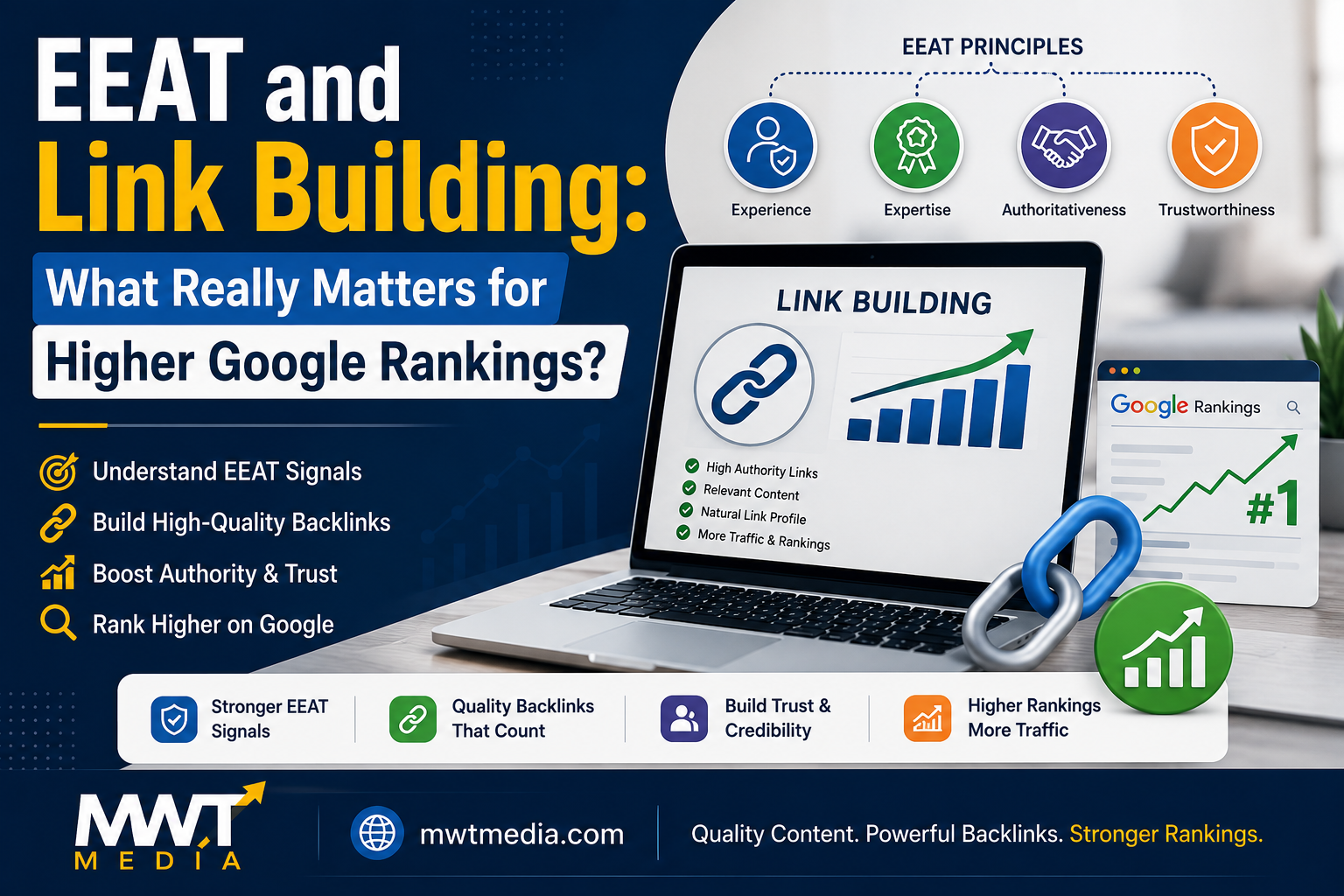
Most SEO arguments about “what actually moves rankings” boil down to two camps. One side swears by content quality and EEAT. The other side swears by backlinks. Both are half right, and that’s the problem — treating them as separate levers is why so many sites plateau.
Google doesn’t rank pages because they satisfy a checklist. It ranks pages it trusts to answer a query well, and trust is built from two directions at once: what the content itself demonstrates about the people behind it, and what the rest of the web says about that content through links. That’s the real relationship between EEAT and Link Building — not two separate tactics, but two halves of the same trust equation.
This article breaks down what EEAT actually means in Google’s current Search Quality Rater Guidelines, why link building still works when it’s done the right way, and how the two reinforce each other in practice. You’ll also find comparison tables, a working checklist, and answers to the questions we hear most often from clients at MWT Media.
What Is EEAT, Really?
EEAT stands for Experience, Expertise, Authoritativeness, and Trustworthiness. Google’s Search Quality Rater Guidelines use it as a framework for human raters to judge whether content deserves to rank — it’s not a direct ranking factor you can “optimize for” in the traditional sense, but it shapes the signals Google’s algorithms are trained to look for.
Here’s the breakdown:
- Experience — Has the creator actually done, used, or lived the thing they’re writing about? A product review from someone who owns the product carries more weight than a rewritten spec sheet.
- Expertise — Does the creator have the knowledge or skill to speak credibly on the topic? This matters more for some topics (medical, financial, legal) than others.
- Authoritativeness — Is the creator or website recognized as a go-to source in its field, by other reputable sources and by users?
- Trustworthiness — Is the content accurate, honest, and safe? Trust is the umbrella term — Google’s guidelines describe it as the most important piece of the four.
Google added the “Experience” element in December 2022, which was a direct response to the flood of AI-generated and thin affiliate content that technically read well but was written by nobody who’d ever touched the product. That single addition changed how a lot of agencies, including ours, approach content briefs.
Why EEAT Isn’t a Ranking Factor (But Still Matters)
Google has said repeatedly that EEAT isn’t a single algorithmic signal you can tick off. Instead, it’s a concept baked into many ranking systems — including the Helpful Content system folded into the core ranking algorithm in 2023. Practically, that means:
- You can’t add an “About the Author” box and expect a ranking jump.
- You can lose visibility if your content shows none of the signals raters and algorithms associate with trustworthy sources.
- The effect compounds. A single unreliable page might not tank you, but a pattern across a site will.
Where Link Building Fits Into the Trust Equation
If EEAT is what your content says about itself, links are what the rest of the internet says about you. A backlink from a respected, topically relevant site is still one of the strongest third-party trust signals Google has, because it’s hard to fake at scale without leaving a footprint.
This is the part people get wrong most often. Link building didn’t stop working after the Penguin updates — what stopped working was link building that ignored relevance, editorial context, and trust. EEAT and Link Building succeed together because a link from a page that itself demonstrates expertise and trust transfers more of that trust than a link from a random directory.
The Old Model vs. The Current Model
| Old Link Building Model | Current Model (EEAT-Aligned) | |
|---|---|---|
| Primary goal | Volume of backlinks | Relevance and editorial trust |
| Link sources | Directories, PBNs, paid link farms | Industry publications, journalists, subject-matter sites |
| Anchor text | Exact-match, keyword-stuffed | Natural, varied, contextual |
| Content used to earn links | Generic guest posts | Original research, data, expert commentary |
| Risk profile | High — manual action exposure | Low — sustainable long-term equity |
| Correlation with rankings | Weak beyond a certain volume | Strong when paired with genuine authority signals |
The Four Pillars of EEAT, Applied to Link Building
It helps to think about each EEAT pillar not just as a content requirement, but as something your link profile should also reflect.
1. Experience Signals in Backlink Sources
A link from a site written by people with hands-on experience in your niche is worth more than a link from a content farm. If you run a SaaS company and get linked from a developer’s personal blog where they detail actually using your API, that’s an experience signal working in your favor twice — once in their content, once in the link itself.
2. Expertise-Driven Outreach
Pitching for links works better when the person doing the outreach — or the person being featured — has real credentials. Journalists and editors increasingly vet sources before linking to them, partly because Google’s own guidelines push publishers to cite credible experts.
3. Authoritativeness Through Topical Clusters
Google doesn’t just look at individual backlinks; it looks at whether a site is recognized as an authority on a topic as a whole. This is where Topical Authority comes in — a site that publishes deeply and consistently on one subject, and earns links across that whole cluster of content, builds a stronger authority signal than one with a single viral page and nothing else.
4. Trustworthiness Through Editorial Context
Links placed within genuine editorial content — where an editor decided the link adds value to their reader — carry trust that paid placements or self-published links don’t. This is the core distinction behind Editorial Backlinks, and it’s the single biggest differentiator between links that help and links that eventually get discounted or penalized.
White Hat Link Building Strategies That Actually Work in 2026
Here are the approaches we prioritize for clients, roughly in order of long-term value.
Digital PR and Data-Driven Content
Original research, surveys, and proprietary data are the most reliable way to earn links from journalists and industry publications. If you’re the only source with a specific statistic, writers have to link back to you to cite it.
Example: A client in the personal finance space ran a survey on remote work spending habits. The resulting data page earned links from over 40 unique domains within three months, including several finance news sites, simply because no one else had the numbers.
Expert Roundups and Source-Based Journalism
Platforms that connect journalists with sources (the successors to the now-retired HARO) remain one of the most direct paths to editorial backlinks from major publications. The key is responding with specific, quotable expertise — not generic marketing copy.
Skyscraper Content, Done Honestly
The “skyscraper” technique — building something more useful than the current top-ranking resource — still works, but it needs to be genuinely better, not just longer. A shorter, clearer, more current resource often outperforms a padded 5,000-word version of the same thing.
Strategic Guest Contributions
Guest posting still has value when it’s done on relevant, high-authority guest post websites with real audiences and editorial standards — not on sites that exist purely to sell links. We covered how to vet these properly in our guide on finding legitimate guest post opportunities.
Broken Link Building and Resource Page Outreach
Finding dead links on resource pages and offering your content as a replacement is slower than it used to be, since most sites have gotten better at maintenance, but it still works in niches with a lot of static reference content.
Digital Sponsorships and Community Involvement
Sponsoring local events, open-source projects, or industry conferences often earns natural, contextual links from .edu, .org, and niche community sites — sources that carry disproportionate trust weight.
Link Building Tactics: What to Use, What to Avoid
| Tactic | Status | Why |
|---|---|---|
| Original research / data studies | Recommended | Earns editorial links naturally |
| Expert quotes for journalists | Recommended | Builds Expertise and Trust signals |
| Guest posts on relevant, vetted sites | Recommended (with caution) | Value depends entirely on site quality |
| Resource page outreach | Recommended | Low volume but high relevance |
| Private blog networks (PBNs) | Avoid | High manual action risk |
| Paid links without disclosure | Avoid | Violates Google’s spam policies |
| Reciprocal link exchanges at scale | Avoid | Pattern is easily detected |
| Automated link submissions | Avoid | Produces low-quality, untrusted links |
| Comment and forum spam links | Avoid | No editorial value, often nofollowed anyway |
How EEAT and Link Building Reinforce Each Other
Here’s the mechanism most explanations skip. Google’s systems don’t evaluate a backlink in isolation — they weigh it against the reputation of the linking page and, by extension, the linking site’s own EEAT profile. A link from a page that itself shows weak expertise or trust signals passes along less value than one from a page that clearly demonstrates them.
That means your link building results are, in part, capped by the EEAT quality of the sites you’re targeting. And your ability to attract links from those sites is capped by your own content’s EEAT. It’s circular, and that’s the point — you can’t shortcut one side to compensate for the other.
Trust Signals sit at the center of this loop. Author bios with verifiable credentials, cited sources, original data, transparent business information, and a site history free of manipulative link patterns all feed into whether both users and Google’s systems treat your domain as trustworthy enough to rank — and trustworthy enough for other sites to want to link to.
A Practical Framework: Building EEAT and Links Together
- Audit your author and business signals first. Before chasing links, make sure your site has clear author attribution, real credentials where relevant, an accurate About page, and verifiable contact information.
- Build topical depth before breadth. Publish comprehensive coverage of your core topics before branching into adjacent ones. This creates the Topical Authority that makes future content easier to rank and easier to get linked.
- Create at least one linkable asset per quarter. Original data, a tool, a template, or a genuinely useful guide — something other sites want to reference, not just something optimized for a keyword.
- Pursue links from sites with their own EEAT strength. A smaller site with real editorial standards is usually worth more than a larger one that publishes anything for a fee.
- Track link quality, not just quantity. Domain relevance, referring page traffic, and editorial context matter more than raw backlink counts.
- Maintain content over time. Outdated statistics and dead internal links erode trust. Revisit cornerstone content at least annually.
EEAT and Link Building Checklist
Use this as a working audit for any page you want to rank competitively.
Content-Level EEAT
- Author byline with real name and relevant credentials
- First-hand experience clearly demonstrated (photos, data, specifics)
- Claims backed by cited, credible sources
- Content reviewed or updated within the last 12 months
- No unsubstantiated claims or exaggerated promises
Site-Level Trust Signals
- Accurate, detailed About and Contact pages
- Clear privacy policy and terms, especially for YMYL topics
- HTTPS and basic technical security in place
- Consistent NAP (name, address, phone) for local businesses
- Reviews or testimonials that are verifiable, not fabricated
Link Profile Health
- Majority of backlinks come from topically relevant domains
- Anchor text distribution looks natural, not exact-match heavy
- No recent spikes in low-quality or spammy referring domains
- At least one active digital PR or outreach campaign running
- Disavow file reviewed if toxic links are identified
Common Mistakes That Undermine Both EEAT and Link Equity
- Publishing AI-generated content with no human review. It’s not that AI content is automatically penalized — it’s that unreviewed, generic AI content rarely demonstrates real experience, which is exactly what raters are trained to notice.
- Buying links in bulk from marketplaces. These almost always come from low-trust, over-optimized networks that do more harm than good once identified.
- Ignoring E-A-T on YMYL pages. Health, finance, and legal content gets held to a stricter standard, and weak sourcing on these pages disproportionately affects visibility.
- Chasing Domain Rating instead of relevance. A high DR link from an unrelated site is often worth less than a moderate DR link from a directly relevant one.
- Letting content go stale. A three-year-old statistics page with no updates signals the opposite of ongoing expertise.
How MWT Media Approaches EEAT and Link Building
At MWT Media, we don’t treat content strategy and link building as separate departments handing off a finished asset. Every campaign starts with an EEAT audit — checking author signals, sourcing, and site trust markers — before a single outreach email goes out. That order matters: content that doesn’t demonstrate genuine expertise is harder to get links for in the first place, and the links it does earn carry less weight.
From there, we build white hat link building campaigns around content genuinely worth citing — original research, expert commentary, and resources that solve a real problem better than what’s currently ranking. It’s slower than mass guest posting or link buying, but it’s the version of link building that survives algorithm updates instead of getting wiped out by them.
How to Measure Whether Your EEAT and Link Building Efforts Are Working
Most teams track rankings and call it a day. That misses the earlier signals that actually predict whether rankings will hold up.
Metrics Worth Watching
- Referring domain relevance, not just count. Ten links from sites in your niche will usually outperform a hundred from unrelated ones. Pull your referring domains list and sort by topical overlap before looking at anything else.
- Branded search volume. A rising trend in people searching your brand name directly is one of the clearest signs that authority is building, since it means people are recognizing and returning to you outside of a single search result.
- Time on page and scroll depth on cornerstone content. If people bounce immediately, that’s often a signal the content doesn’t deliver on the experience or expertise it promises, regardless of how it’s optimized.
- Toxic link ratio. Tools like Ahrefs or Semrush flag suspicious referring domains. A sudden spike usually means either a negative SEO attempt or a leftover from an old, riskier campaign that needs cleaning up.
- Content freshness score. How much of your top-performing content has been reviewed or updated in the last twelve months? Stale cornerstone pages are a quiet drag on trust even when nothing else has changed.
A Simple Monthly Review
We run a short version of this with clients every month:
- Pull new referring domains and manually check the top ten for relevance and quality.
- Compare branded search trend against the previous quarter.
- Flag any cornerstone pages that haven’t been touched in over ten months.
- Review anchor text distribution for anything that looks over-optimized.
- Cross-check ranking movement against algorithm update logs, since a drop right after a core update means something different than a slow decline over months.
None of this requires expensive tooling. A spreadsheet and thirty minutes a month catches most problems before they become expensive ones.
EEAT and Link Building for Different Business Types
The right mix shifts depending on what kind of site you’re running.
Local businesses get more value from citations, Google Business Profile signals, and links from local news, chambers of commerce, and community organizations than from national digital PR campaigns. A plumber in Austin doesn’t need a link from a national tech blog — they need to show up as a trusted, verified local entity.
SaaS and B2B companies benefit most from integrations, partner pages, comparison content, and being cited in industry reports. Expertise here often comes from product documentation, case studies, and technical founders speaking directly about how something works.
E-commerce sites lean harder on reviews, unboxing and comparison content from real buyers, and links from gift guides or product roundups. Experience signals — actual photos, actual usage — carry disproportionate weight here because so much e-commerce content is templated.
YMYL sites (health, finance, legal) face the strictest scrutiny. Author credentials need to be real and verifiable, sourcing needs to point to primary research or recognized institutions, and link building should lean almost entirely toward earned, editorial placements rather than anything that could look like a paid arrangement.
Frequently Asked Questions
Is EEAT a direct Google ranking factor? No. Google has confirmed EEAT is a concept used in its Search Quality Rater Guidelines and reflected across various ranking systems, including the Helpful Content system, rather than a single measurable signal you can target directly.
Do backlinks still matter in 2026? Yes. Backlinks remain one of the strongest signals for authority and relevance, but the quality and relevance of the linking source matter far more than raw quantity now.
What’s the difference between white hat and black hat link building? White hat link building earns links through genuine value — original content, data, and relationships. Black hat methods involve paid, automated, or manipulative link schemes designed to game rankings rather than earn trust.
How many backlinks does a page need to rank? There’s no fixed number. A page can outrank competitors with far more backlinks if its links come from more relevant, higher-trust sources and its content demonstrates stronger EEAT signals.
Can AI-written content ever satisfy EEAT? It can, if a knowledgeable human reviews, fact-checks, and adds genuine experience or expertise to it. The issue isn’t the tool used to draft content — it’s whether the final result reflects real expertise and accuracy.
What are Editorial Backlinks, and why do they matter more than other links? Editorial backlinks are links an independent editor or writer includes because it genuinely benefits their readers, not because it was paid for or exchanged. They carry more trust because they weren’t manufactured, which is exactly what Google’s systems are designed to detect and reward.
How long does it take to see ranking improvements from EEAT and link building efforts? Most sites see meaningful movement within three to six months, though YMYL topics and highly competitive niches can take longer since trust signals compound gradually rather than triggering an immediate jump.
Final Thoughts
The sites winning in competitive search results right now aren’t the ones with the most backlinks or the most polished author bios in isolation. They’re the ones where both sides of the equation hold up under scrutiny — content that actually demonstrates experience and expertise, earning links from sources that do the same.
EEAT and Link Building aren’t competing strategies. They’re the same strategy, viewed from two angles: what you say about yourself, and what the rest of the web is willing to vouch for. Get both working together, and rankings tend to follow — not because you gamed a system, but because you built something worth trusting.

Daniel
Daniel is an SEO & Content Writer at MWT Media, specialising in crafting data-driven content that ranks. With a deep understanding of search engine optimisation, keyword strategy, and audience engagement. He creates compelling articles, blog posts, and web copy that not only attract organic traffic but convert readers into customers. At MWT Media, Daniel plays a key role in developing content strategies that align with client goals — from on-page SEO optimisation to high-quality guest posting campaigns.