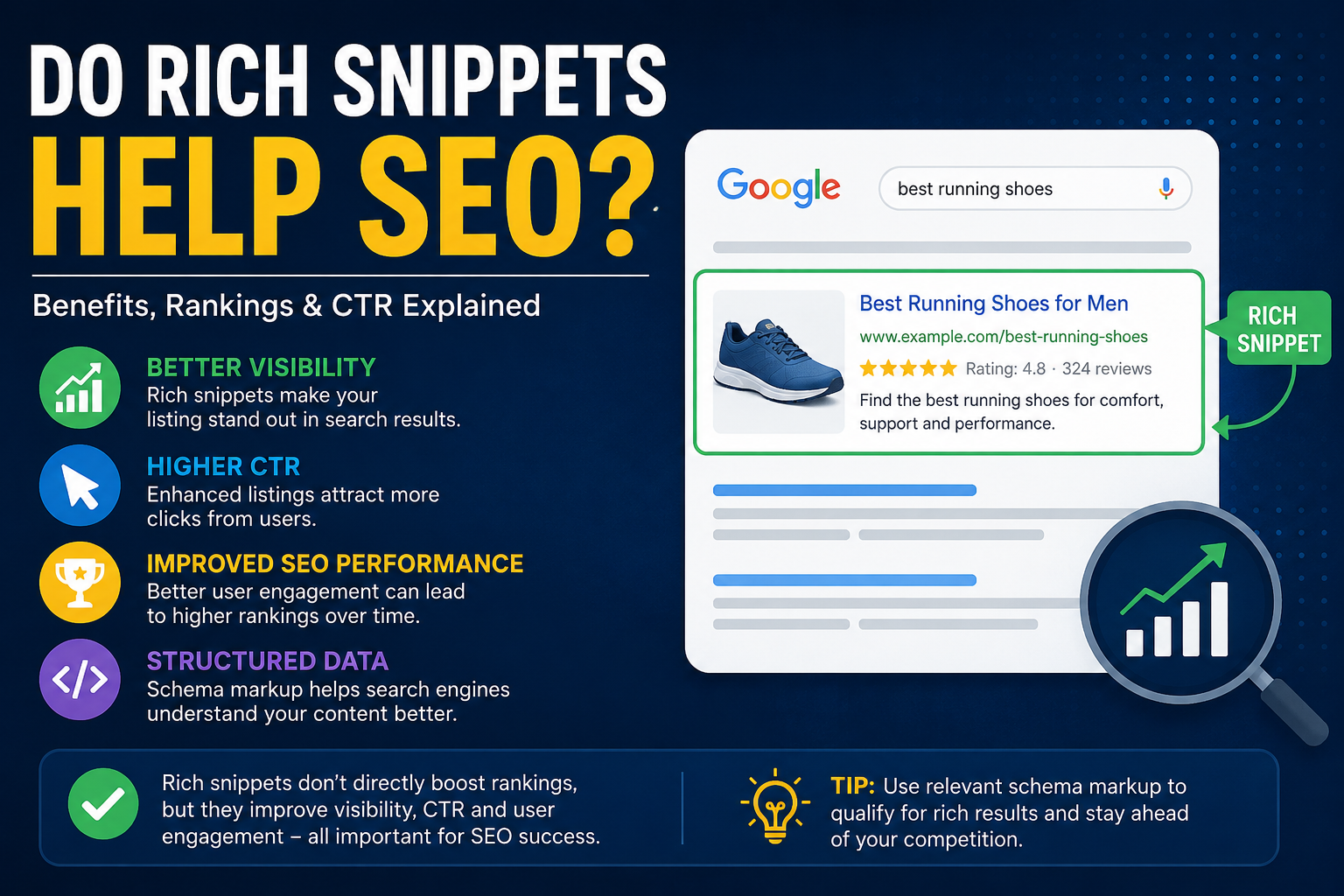
If you’ve spent any time researching on-page optimization, you’ve probably asked yourself: do rich snippets help SEO, or are they just a cosmetic upgrade to your search listing? It’s a fair question. Rich snippets look impressive in the SERPs — star ratings, prices, FAQs, recipe times — but do they actually move the needle on rankings, traffic, and conversions? We dug into how rich snippets work, what Google actually says about them, and what real-world data shows.
What Are Rich Snippets, Exactly?
Rich snippets are enhanced search results that display extra information beyond the standard blue link, page title, and meta description. They’re generated using structured data (usually Schema.org markup) that tells search engines exactly what a piece of content represents — a product, a review, a recipe, an event, or an FAQ.
Common types of rich snippets include:
- Review stars — showing average ratings for products or services
- Recipe cards — with cook time, calories, and ingredient counts
- FAQ dropdowns — expandable questions directly in the search result
- Product snippets — price, availability, and stock status
- Breadcrumbs — showing site hierarchy instead of a raw URL
- Event snippets — dates, locations, and ticket info
So, Do Rich Snippets Help SEO Rankings?
Here’s the nuanced answer: rich snippets do not directly influence your organic ranking position. Google has confirmed multiple times that structured data is not a ranking factor on its own. Adding schema markup won’t magically push you from position 8 to position 1.
However, when people ask “do rich snippets help SEO,” they’re usually asking about SEO performance as a whole — not just raw ranking position. And that’s where the answer changes.
Rich snippets influence SEO indirectly, primarily through:
1. Improved Click-Through Rate (CTR)
- This is the biggest and most well-documented benefit. A listing with star ratings, an FAQ dropdown, or a price tag naturally draws more attention than a plain blue link. Higher CTR means more visitors choosing your result over a competitor’s — even from the same ranking position.
2. Increased SERP Real Estate
- Rich results, especially FAQ and “People Also Ask” style snippets, take up more vertical space on the results page. This pushes competitors further down and increases your visibility, even without a ranking change.
3. Better User Signals
- More clicks and more relevant traffic can lead to better engagement metrics — lower bounce rates, longer time on page. While Google hasn’t confirmed these as direct ranking signals, strong user engagement is generally correlated with better long-term rankings.
4. Voice Search and Featured Snippet Eligibility
- Structured data — particularly FAQ and HowTo schema — makes your content easier for Google to parse and pull into voice search results or featured snippets (position zero), which is one of the most valuable spots in search.
What the Data Actually Shows
Industry studies on structured data consistently point to CTR improvements rather than ranking improvements. Pages with rich snippets, particularly review stars and FAQ markup, tend to see measurable increases in click-through rate compared to standard listings at the same position. The effect varies by industry — e-commerce and recipe sites tend to benefit the most, since visual elements like pricing and star ratings are highly persuasive at a glance.
It’s worth noting that correlation isn’t causation here. A well-optimized page that earns rich snippets is often already strong in other SEO areas — content quality, site structure, backlinks — so isolating the exact impact of the snippet itself can be tricky.
How to Get Rich Snippets on Your Pages
If you’re convinced rich snippets are worth pursuing, here’s the basic process:
- Choose the right schema type for your content (Product, FAQ, Review, Recipe, Article, etc.)
- Implement structured data using JSON-LD (Google’s preferred format)
- Validate your markup with Google’s Rich Results Test
- Monitor performance in Google Search Console under the “Enhancements” section
- Be patient — rich results aren’t guaranteed even with valid markup; Google decides when and if to display them
Common Mistakes to Avoid
- Marking up content that isn’t visible on the page (this violates Google’s guidelines)
- Using fake or inflated review ratings
- Implementing schema incorrectly, causing errors in Search Console
- Expecting instant ranking boosts instead of CTR improvements
Final Verdict: Do Rich Snippets Help SEO?
To directly answer the question — do rich snippets help SEO — the honest answer is: not by boosting your ranking position, but yes, by improving click-through rate, visibility, and user engagement, all of which support stronger overall SEO performance over time. Think of rich snippets less as a ranking hack and more as a conversion and visibility tool that works alongside solid technical and content SEO.
If your goal is simply to rank higher, focus on content quality, backlinks, and technical SEO first. But if you want to get more clicks out of the ranking you already have, implementing structured data for rich snippets is one of the easiest, lowest-risk improvements you can make.

Daniel
Daniel is an SEO & Content Writer at MWT Media, specialising in crafting data-driven content that ranks. With a deep understanding of search engine optimisation, keyword strategy, and audience engagement. He creates compelling articles, blog posts, and web copy that not only attract organic traffic but convert readers into customers. At MWT Media, Daniel plays a key role in developing content strategies that align with client goals — from on-page SEO optimisation to high-quality guest posting campaigns.