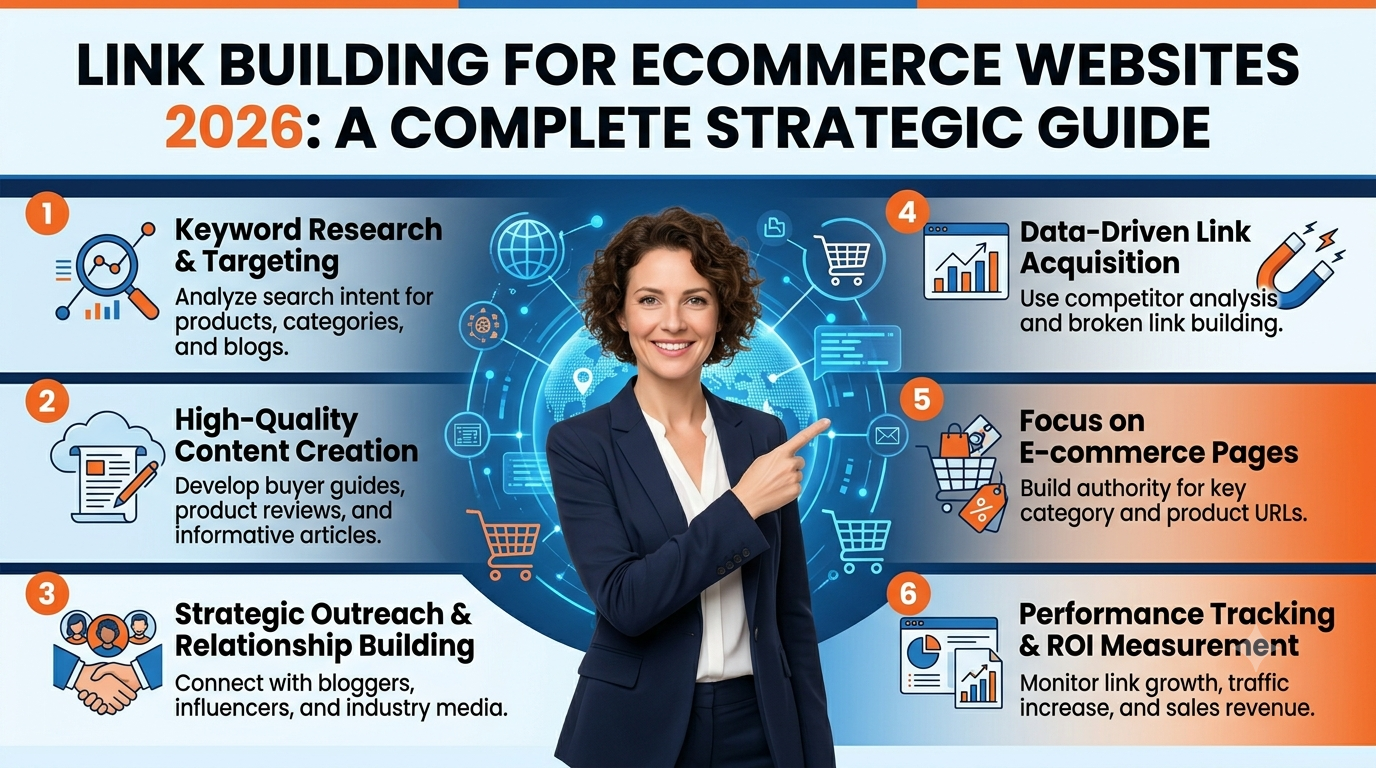
Link building has not gone away in 2026, but it has gotten harder, more expensive, and far less forgiving of shortcuts. For online stores specifically, the challenge is structural: nobody wants to link to a product page. A blogger, journalist, or site owner sees a product listing as an advertisement, not a resource worth citing. Meanwhile, Google’s spam systems have become noticeably better at spotting the manipulative tactics that used to paper over that problem, and AI-driven search has opened an entirely new front where brand authority, not just backlinks, decides whether a product gets recommended at all.
This guide pulls together what is actually working for link building for ecommerce websites 2026, why product-page-direct link building is the wrong target, and how stores of different sizes should budget and sequence their efforts.
Why Link Building Still Matters for Online Stores
Backlinks remain one of Google’s most consistent ranking signals, and the data backing that up has only gotten stronger. Roughly a quarter of all ecommerce orders are estimated to originate directly from organic search, and customers arriving through organic search tend to convert at noticeably higher rates than those arriving through outbound marketing channels. Search visibility, in other words, is not a vanity metric for online retail; it is a revenue channel.
Ahrefs ran a controlled disavow experiment that offers some of the clearest causal evidence available: disavowing a site’s backlinks produced a 13.3% drop in organic traffic, and reinstating those same links recovered traffic to essentially its original level. That single experiment confirms what most SEOs have assumed for years but rarely had hard proof of links are still doing real ranking work, not just correlating with it.
Industry investment reflects that confidence. A 2026 survey of more than 500 SEO professionals by Editorial.Link found that link building consumes roughly 32% of the average agency’s total SEO budget, making it the single largest line item ahead of content production or technical SEO.
The Core Problem: Product Pages Don’t Attract Links
Most general link building advice is written with SaaS companies, publishers, and service businesses in mind sites where the page you want to rank is also the page that’s genuinely useful to read. Ecommerce breaks that assumption. A BuzzStream trends analysis found that about 68% of link builders prioritize links to blog content, while only around 14% prioritize links directly to product pages, simply because editors and bloggers are reluctant to link to something that reads as a sales pitch.
The practical fix is architectural rather than tactical: build link-worthy content assets, then use deliberate internal linking to funnel the authority those assets earn toward the product and category pages that actually generate revenue. A buying guide that picks up fifty backlinks accomplishes nothing for your bottom line if it doesn’t link internally to the products it’s discussing. The content earns the links; the internal link structure decides who benefits from them.
The assets that consistently earn links for ecommerce brands tend to fall into a few categories: comprehensive buying guides (“How to Choose the Right [Product] in 2026”) that become reference material for other writers covering the same category; original research built from customer surveys, sales data, or proprietary usage statistics, which journalists and bloggers cite because the numbers don’t exist anywhere else; and interactive tools such as size calculators, product finders, or comparison tools that other content creators want to point their own readers toward. Even a modest library of ten to fifteen well-built guides can function as the foundation of an entire link program for a smaller store.
Digital PR: The Highest-Leverage Strategy for 2026
Across nearly every recent analysis of ecommerce link building, digital PR comes up as the tactic with the best return for the effort involved, for a simple reason: a single piece of press coverage delivers a high-authority backlink and a brand mention at the same time, and that brand mention is increasingly valuable in its own right (more on that below).
Running digital PR for an online store generally starts with identifying a genuine news angle a sustainability initiative, an unusual product design choice, or proprietary customer data that nobody else has. From there, positioning a founder or in-house expert as a source for journalists pays off over time. Platforms like HARO, Featured, and Qwoted connect reporters looking for quotes with brands willing to provide them, and a consistent daily habit of responding to relevant queries even just thirty minutes a day tends to compound into a steady trickle of high-quality editorial links.
Other Strategies That Are Actually Working
Several other tactics show up repeatedly across current ecommerce SEO research as reliable, white-hat ways to build authority:
Product seeding and reviewer outreach gets your products into third-party roundups, gift guides, and comparison articles the “Best Camping Tents of 2026” style content that shoppers actively search for before buying. A feature in a trusted publication delivers both a strong backlink and referral traffic that tends to convert well, since the reader has already been primed by an independent recommendation.
Unlinked brand mention reclamation is one of the lowest-effort, highest-conversion tactics available. Many sites mention a brand or product by name without linking to it. Monitoring tools can surface these mentions, and a polite outreach note thanking the author and suggesting a link would help their own readers tends to land well precisely because you’re not asking for something from nothing; they’ve already decided your brand was worth mentioning.
Broken link building still works, with some refinement. Rather than mass-targeting any dead link you can find, the better approach is identifying broken links on pages that are themselves authoritative, topically relevant, and still receiving traffic for instance, a popular gear guide linking to a now-defunct competitor’s product page. Offering your own product or buying guide as the replacement leverages link equity the site owner already decided was worth including once.
The skyscraper technique finding an existing piece of content that has accumulated dozens of backlinks, building a more current and more useful version, then reaching out to the sites linking to the original continues to convert a meaningful share of outreach into new links, especially in categories where “best of” content goes stale quickly.
Guest posting still has a place, but it works best indirectly. Placing a guest post that links to an informational page on your own site a buyer’s guide or comparison page and then letting your internal linking carry that authority toward product pages outperforms trying to force a product link directly into someone else’s editorial content.
Long-term influencer and affiliate partnerships, separate from paid social promotion, often produce a handful of genuine dofollow links per year as a byproduct of associated blog or newsletter content, since most social platforms strip link equity from posts but the creator’s own website usually doesn’t.
What to Avoid: Google’s 2026 Enforcement Has Sharpened
Google’s spam-detection system, SpamBrain, received a significant upgrade in early 2026, and the practical effect has been a much narrower margin for error around manipulative link tactics. Recent enforcement activity has specifically targeted private blog networks refreshed with AI-generated content, expired-domain abuse (acquiring an old domain purely to inherit its backlink authority and repurposing it for unrelated content), parasite SEO arrangements where low-quality third-party content is hosted on a high-authority domain to borrow its ranking power, and paid link-insertion deals structured to obscure the sponsored relationship.
Ecommerce sites have specific exposure here. Thin affiliate pages, manufacturer product descriptions copied verbatim across hundreds of listings, doorway-style category pages, and manipulative internal linking schemes have all been flagged in recent enforcement waves. Stores with unique product descriptions and authentic customer reviews have generally held their rankings through these updates, while stores relying on copied feed content lost visibility on exactly the category and product pages link building is meant to support.
Google has also been explicit that ranking benefits removed from spammy links do not return even after the links are cleaned up the boost was never legitimate to begin with, so there’s nothing to restore. That asymmetry is the single best argument for sticking to earned links rather than acquired ones, regardless of how slow earning them feels by comparison.
What Link Building Costs in 2026
Pricing varies considerably by tactic and by how directly a link points at a commercial page. Current market data puts standard guest posts at roughly $77–$609 per placement, niche edits (inserting a link into existing, already-ranking content) at $141–$361, and high-authority editorial placements secured through digital PR at $700–$2,000 or more. HARO-style media placements cost little in cash but require a meaningful time investment in pitching. Managed link building retainers from agencies typically run $1,000–$5,000+ per month, and a quality link from a strong, topically relevant editorial site averages somewhere between $508 and $1,000 in true acquisition cost once outreach time is factored in.
Because ecommerce link building usually has to fund link-worthy content (guides, tools, research) on top of outreach, total program costs run higher than they would for a typical content site. A reasonable industry benchmark for 2026 puts most ecommerce link building budgets at $1,500–$8,000 per month depending on competitiveness, with moderately competitive category pages generally needing somewhere between fifteen and fifty referring domains to rank, and high-traffic product pages needing a more modest five to twenty.
| Tactic | Typical cost range |
|---|---|
| Guest post | $77 – $609 |
| Niche edit / link insertion (white-hat) | $141 – $361 |
| HARO / journalist pitch | $0 – $200 (plus time) |
| High-authority digital PR placement | $700 – $2,000+ |
| Managed agency retainer | $1,000 – $5,000+/month |
Outsourcing It: Where an Agency Like MWT Media Fits
Not every store has the time to run outreach, vet publishers, and chase journalists in-house, which is why a meaningful share of ecommerce link building budgets goes to agencies rather than internal teams. MWT Media is one of the providers operating in this space, positioning itself as a digital marketing agency built around customized, white-hat link-building campaigns rather than off-the-shelf packages. Its stated approach starts with research before outreach identifying authoritative, topically relevant sites in a client’s niche rather than acquiring whatever placements are cheapest or fastest which lines up with the broader shift this guide has covered: relevance and editorial quality now outweigh raw link volume or domain-rating chasing.
For an ecommerce brand specifically, the case for bringing in a partner like MWT Media usually comes down to three things. First, it removes the most time-consuming part of any link program manually vetting dozens of prospective publishers for real traffic, editorial standards, and topical fit before a single outreach email goes out. Second, an agency focused on quality over quantity is, in theory, building toward the metrics that actually move ecommerce rankings: domain authority, niche relevance, and brand exposure, rather than a vanity count of total links acquired. Third, it gives a smaller store without a dedicated PR or content team a way to access ongoing outreach and relationship-building without hiring that function internally.
That said, the diligence questions are the same no matter which agency a store is evaluating, MWT Media included: ask to see live placements on sites with genuine organic traffic rather than just metrics screenshots, confirm the agency avoids PBNs, link farms, and expired-domain tactics, and get clear, per-placement pricing so cost-per-link can be calculated honestly against expected traffic value. Any agency worth retaining should hold up against the same white-hat checklist outlined earlier in this guide.
The New Wrinkle: AI Search and Brand Authority
The biggest shift specific to 2026 is that link building is no longer only about ranking in traditional blue links. Google’s AI Overviews now appear on a majority of US searches, and the overlap between pages cited inside an AI Overview and pages ranking in the conventional top ten is surprisingly thin only about a third of AI-cited pages also rank organically in the top ten. Citation and ranking have become two related but distinct games.
This matters for link building because the same brand-authority signals that earn editorial backlinks also appear to influence whether AI systems recommend a product at all. Ahrefs has reported a strong correlation between how often a brand is mentioned across the web and how likely it is to be recommended by AI tools. A brand that’s been cited as an expert source by outlets like Healthline or Apartment Therapy carries far more weight with AI recommendation systems than one with only product pages and a handful of guest post links. There’s also early evidence that AI-referred shoppers convert well: one analysis of nearly a hundred ecommerce sites found that traffic referred from ChatGPT converted at meaningfully higher rates than typical non-branded organic search traffic.
The practical implication is that digital PR and unlinked-mention reclamation now do double duty they build the conventional backlink profile Google has always rewarded, and they build the brand-mention footprint that AI systems increasingly use to decide what to recommend. Stores that aren’t yet tracking whether AI chatbots mention their products are missing a fast-growing discovery channel.
Measuring Whether It’s Working
The right KPIs for an ecommerce link building program go beyond simple link counts. Domain authority/rating gives a directional sense of overall site strength, but referral traffic and the conversion rate of that referral traffic tell you whether the links are actually reaching people who buy. Tracking keyword rankings for the specific category and product pages tied to a campaign rather than the domain as a whole isolates whether a given push is moving the pages that matter. Increasingly, monitoring brand mentions inside AI chatbot responses is worth adding to that list as a forward-looking signal, even though the analytics tooling for it is still maturing.
A Realistic Timeline
Link building compounds rather than spikes, and ecommerce sites should plan around that. In the first one to three months, expect technical and content foundations schema markup, unique product descriptions, the initial batch of buying guides and link-worthy assets to matter more than outreach volume. Between roughly three and six months, broken link building, guest posting, and early content-driven outreach typically start producing a steady trickle of links and the first improvements on less competitive keywords.
Past six to twelve months, digital PR, original research, and a maturing content library tend to generate the bulk of ongoing link acquisition, with established programs producing somewhere in the range of thirty to a hundred-plus quality links annually. Consistency outperforms intensity here: a steady five quality links a month sustained over a year tends to beat a thirty-link burst followed by months of inactivity, both because Google rewards a natural acquisition pattern and because the underlying content keeps earning links long after the initial outreach push ends.
The Bottom Line
Ecommerce link building in 2026 rewards patience and penalizes shortcuts more decisively than it has in years past. The sites pulling ahead are the ones treating it as a content and brand-authority problem rather than a backlink-acquisition problem: building genuinely useful guides, tools, and research; earning real editorial coverage through digital PR; converting brand mentions and dead links into earned authority; and routing that authority deliberately, through internal linking, to the product and category pages that drive revenue.
The sites falling behind are largely the ones still chasing volume through PBNs, expired domains, or disguised paid placements tactics that Google’s spam systems are now catching with enough precision that the ranking benefit, once stripped away, doesn’t come back.