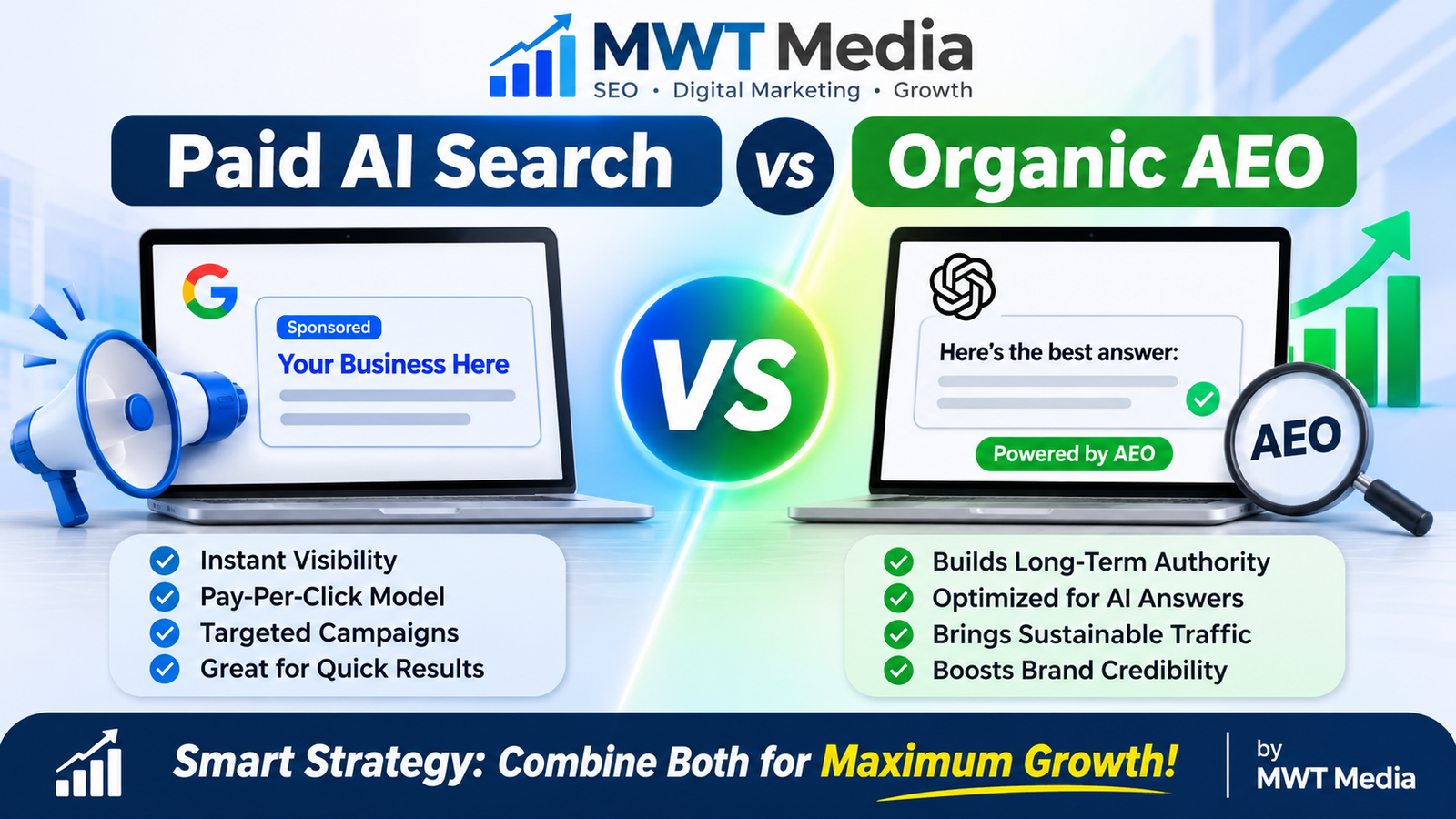
Search marketing is entering a new phase. People are no longer relying exclusively on traditional search results to discover businesses, compare products, or find solutions to everyday problems. They are increasingly asking conversational questions, exploring AI-generated summaries, and using AI assistants to research their options before making decisions.
For businesses, this shift creates two important opportunities: paying for visibility through AI-enabled advertising and earning visibility through Answer Engine Optimization (AEO). Both approaches can help brands reach potential customers, but they work differently and serve distinct marketing objectives.
Understanding paid ai search vs organic aeo is becoming essential for marketers who want to adapt their strategies without wasting advertising budgets or overlooking long-term organic growth opportunities.
What Is Paid AI Search?
Paid AI search refers to advertising opportunities within AI-powered search experiences. Instead of relying exclusively on traditional search ads, businesses can reach users as they explore AI-generated answers, product comparisons, and conversational search results.
For example, someone might ask an AI-powered search engine, “What is the best SEO agency for a small e-commerce business?” Depending on the platform, query, and available advertising features, relevant sponsored listings may appear alongside or within the AI search experience.
Google has introduced advertising placements in AI-powered Search experiences, including AI Overviews and AI Mode. Eligible Search, Shopping, and Performance Max campaigns can participate in these opportunities, subject to platform eligibility and market availability.
Google Ads Help+1
Paid AI search offers several potential advantages:
Faster visibility: Businesses can reach eligible audiences without waiting for organic rankings to improve.
Targeted reach: Advertising systems can match campaigns with commercially relevant searches and user needs.
Budget control: Advertisers can set budgets, manage bids, and optimize campaigns around business objectives.
Measurable performance: Clicks, conversions, cost per acquisition, and return on ad spend help marketers evaluate results.
Commercial intent: Relevant placements can reach users who are actively comparing products or considering a purchase.
However, paid visibility is not guaranteed for every query. Ad placement depends on factors such as campaign eligibility, auction outcomes, relevance, and the search platform’s policies. Advertising also does not guarantee that an AI assistant will recommend a business in its organic answers.
What Is Organic AEO?
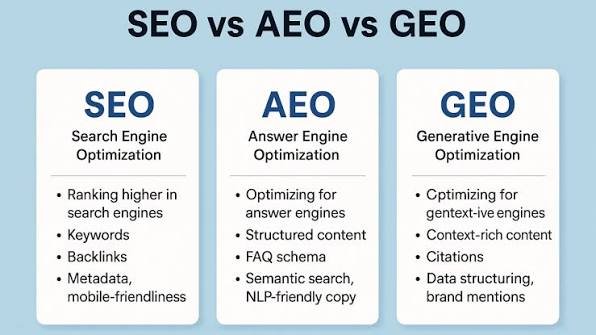
Answer Engine Optimization, commonly known as AEO, is the practice of improving a brand’s chances of being accurately represented, referenced, or cited in answers generated by search engines and AI assistants.
Traditional SEO generally focuses on improving a website’s visibility in search results. AEO builds on many of the same foundations but places additional emphasis on making information easy to understand, extract, verify, and use when an answer engine responds to a question.
Consider a company that provides guest posting and link-building services. A potential customer asks an AI assistant to recommend agencies that offer relevant websites, transparent pricing, and contextual backlinks. The assistant may draw on indexed website content, reputable third-party publications, company information, and other available sources when preparing its response.
AEO aims to make a business’s information useful, credible, and accessible within these discovery experiences. It cannot guarantee a citation or recommendation, because answer engines determine which sources to use.
Effective organic AEO typically involves:
Answer-focused content: Addressing specific customer questions clearly and directly.
Strong topical coverage: Publishing useful, well-organized information about products, services, and industry problems.
Technical SEO: Maintaining crawlable pages, sound indexing, logical site architecture, and accessible content.
Credible evidence: Supporting claims with reliable sources, original research, real examples, and transparent business information.
Third-party credibility: Earning relevant editorial mentions, genuine reviews, and references from trustworthy publications.
Content accuracy: Keeping service descriptions, pricing, statistics, and other important information current.
Google’s official guidance confirms that established SEO fundamentals remain relevant to AI-powered Search features. It does not require a separate set of special optimizations for inclusion in AI Overviews or AI Mode.
Google for Developers+1
The key distinction is that organic AEO seeks to earn visibility through useful and credible information rather than purchasing an advertisement for every opportunity.
Paid AI Search vs Organic AEO: Key Differences
Although both strategies aim to improve brand visibility, their underlying mechanisms differ.
| Factor | Paid AI Search | Organic AEO |
|---|---|---|
| Primary approach | Paid advertising placements | Earned visibility in AI-generated answers |
| Initial investment | Advertising budget and campaign management | Content, SEO, research, and optimization resources |
| Time to visibility | Potentially faster after campaign eligibility and approval | Usually requires sustained effort, with no guaranteed timeline |
| Visibility control | Bid, budget, and campaign settings influence delivery | Limited direct control over citations and recommendations |
| Traffic potential | Depends on eligible impressions, clicks, and campaign performance | Depends on relevant mentions, citations, and resulting visits |
| Measurement | Ad impressions, clicks, conversions, CPA, and ROAS | AI citations, brand mentions, referral visits, conversions, and assisted revenue |
| Long-term value | Visibility generally depends on continued campaign eligibility and spend | Useful content and earned authority can continue creating value |
| Main limitation | Costs and auction competition | Uncertain inclusion and limited direct control |
One important distinction deserves attention: paid AI search and organic AEO are not mutually exclusive alternatives. A company can advertise to capture immediate demand while building organic visibility to strengthen its position over time.
How Paid AI Search Works in Practice
Paid AI search is most useful when businesses have a clear commercial objective and want to reach customers at relevant moments in their decision-making process.
Imagine an online store selling skincare products. Rather than depending entirely on organic discovery, the business can run eligible search or shopping campaigns to reach people researching products for specific skin concerns.
The process generally involves four steps:
Identify commercial opportunities. Research the questions, product categories, and search terms that indicate genuine buying intent.
Build relevant campaigns. Create advertising assets and landing pages that address the needs behind those searches.
Optimize campaign performance. Use conversion tracking, bidding strategies, and relevant audience or query signals to improve results.
Measure profitability. Evaluate whether the revenue or qualified leads generated justify the advertising expenditure.
AI-powered search experiences introduce another consideration: users may ask several related questions before deciding what to buy. Advertising systems can use the context of these conversations to identify relevant opportunities where supported.
Google’s advertising guidance recommends combining suitable AI-powered targeting with reliable conversion measurement, relevant landing pages, and well-maintained campaign assets.
Google Ads Help+1
For businesses, the practical lesson is straightforward: appearing in an AI search experience matters less than reaching the right audience with an offer that converts.
How Organic AEO Builds Long-Term Visibility
Organic AEO requires a different mindset. Instead of paying for each advertising opportunity, businesses work to establish their content as a useful source of information for search engines and AI systems.
This process starts with understanding what potential customers want to know.
For example, a digital marketing agency might publish detailed answers to questions such as:
What is guest posting in SEO?
How can businesses evaluate the quality of a backlink?
What is the difference between SEO and AEO?
How much should a business spend on link building?
How can companies measure visibility in AI-generated answers?
These articles should provide meaningful answers rather than simply repeating keywords. They can include original insights, examples, supporting evidence, clear headings, and relevant links to deeper resources.
A well-developed AEO strategy also considers the credibility of information outside the company’s own website. Genuine industry mentions, independent reviews, and authoritative references can help establish a clearer picture of the business.
However, there is no guaranteed formula for getting cited by an AI assistant. Search visibility, content quality, source availability, and the particular question being asked all influence the outcome.
Why Traditional SEO Still Matters
Some businesses assume that AI search requires abandoning traditional SEO. That is a mistake.
Technical accessibility, relevant content, internal linking, sound information architecture, and clear page purpose remain valuable foundations. Google’s documentation explains that its AI Search features use established Search systems and indexed web content to help generate responses.
Google for Developers+1
In practical terms, businesses should improve their SEO foundations before investing heavily in additional AEO tactics. A page that cannot be crawled or indexed properly may struggle to earn organic visibility in the first place.
Which Strategy Offers Better ROI?
The answer depends on the business model, available resources, competition, and how quickly results are needed.
Paid AI search can provide a more direct route to testing commercial demand. Organic AEO may support long-term discoverability and brand credibility. Neither strategy automatically produces a better return.
Consider a hypothetical software company spending $1,000 per month on paid search campaigns. If it generates 20 qualified leads, its advertising cost per lead is $50.
Now imagine the same company invests in AEO-focused content and technical improvements. After several months, the content begins attracting relevant visitors and generating qualified leads. Its initial investment may take longer to recover, but useful content could continue contributing to acquisition after publication.
These are illustrative examples, not expected performance benchmarks. Actual results depend on conversion rates, sales value, competition, execution, and ongoing costs.
To compare the two strategies fairly, businesses should evaluate:
Cost per qualified lead: How much does it cost to attract a prospect who fits the target market?
Customer acquisition cost: What is the total cost of acquiring a paying customer?
Conversion rate: How often do relevant visitors or leads become customers?
Revenue contribution: Which channels influence completed sales and customer lifetime value?
Long-term efficiency: Does performance continue when advertising budgets are reduced, or does organic visibility sustain part of the demand?
For AEO, tracking should extend beyond website traffic. Brand mentions, AI citations, referral sessions, assisted conversions, and qualified leads can provide additional evidence of performance. Citation tracking alone, however, does not prove that a campaign generates revenue.
How Businesses Can Combine Paid AI Search and Organic AEO

For many organizations, a combined strategy is more practical than choosing one approach exclusively.
Advertise relevant products and services, then identify which queries, offers, and landing pages generate qualified conversions. Use the results to inform broader marketing decisions.
Develop articles, service pages, comparison guides, and FAQs that address genuine customer needs. Focus on accurate answers and meaningful detail rather than producing large volumes of repetitive content.
Improve technical SEO, maintain consistent business information, earn relevant editorial coverage, and support important claims with evidence. Avoid artificial mentions designed solely to manipulate AI recommendations.
Track paid conversions alongside organic search performance, AI referral traffic, brand mentions, and assisted revenue. Use consistent attribution rules to avoid counting the same customer acquisition multiple times.
This approach creates a feedback loop: paid campaigns provide information about commercial demand, while organic content builds a broader foundation for discovery and customer education.
Businesses should also avoid assuming that advertising automatically improves organic AI recommendations. Google explicitly states that buying ads does not influence the organic responses generated by its AI Search features.
Common Mistakes to Avoid
As AI search becomes a more prominent part of digital marketing, businesses may be tempted to chase quick wins. Several mistakes can undermine their efforts.
Treating AEO as a replacement for SEO. Organic visibility in AI answers still benefits from a technically sound website and useful, accessible content.
Expecting immediate organic results. Publishing optimized articles does not guarantee citations, recommendations, or traffic within a fixed period.
Paying for every available advertising opportunity. More spending does not necessarily mean more profitable customers. Campaigns should be evaluated against conversion quality and business goals.
Publishing content solely for AI systems. Repetitive, shallow pages are unlikely to provide lasting value to users. Clear answers, original expertise, and reliable information should remain the priority.
Ignoring brand reputation. AI-generated recommendations can draw on information from multiple sources. Inconsistent business details, unsupported claims, and poor customer experiences can undermine credibility.
Measuring visibility without measuring outcomes. An increase in AI mentions may be encouraging, but businesses also need to understand whether those mentions contribute to relevant visits, leads, and revenue.
What Does the Future of Search Marketing Look Like?
The future of search marketing is likely to involve a wider range of discovery experiences, from traditional search results to conversational AI interfaces and more contextual advertising placements.
Users can ask longer questions, compare several options in one conversation, and explore recommendations without following the traditional path of clicking through multiple search results. For marketers, this makes relevance and usefulness increasingly important.
Google’s October 2026 announcement described expanding ads in AI Mode to additional markets, including Pakistan, while its documentation notes that eligibility and language availability vary by placement.
This creates new opportunities for advertisers, but businesses should distinguish between paid placements and organic inclusion. The two channels may appear within related discovery experiences while operating under different systems.
Organic AEO will also continue to evolve as AI assistants and answer engines change how they retrieve information and select sources. Rather than relying on speculative shortcuts, businesses should invest in the fundamentals that support durable visibility: accurate information, useful content, technical accessibility, genuine expertise, and a trustworthy brand.
The strongest search marketing strategies will likely combine multiple channels while measuring each according to its contribution to business growth.
Final Verdict: Paid AI Search vs Organic AEO
The debate around paid AI search vs organic AEO is not really about deciding which strategy will eliminate the other. It is about understanding what each can accomplish and using them where they offer the greatest value.
Paid AI search is worth considering when a business needs to test demand, reach commercially relevant audiences, and measure campaign performance through advertising data. Organic AEO is valuable for companies seeking to improve their chances of being referenced in AI-generated answers through useful content, credible information, and sound SEO foundations.
Businesses with sufficient resources can combine both approaches. Those with limited budgets should prioritize based on their immediate goals, competitive position, and ability to measure results.
Ultimately, paid AI search can help businesses buy eligible advertising visibility, while organic AEO focuses on earning visibility through relevance and credibility. A sustainable search marketing strategy recognizes the difference, avoids unrealistic promises, and connects visibility to measurable commercial outcomes.
Frequently Asked Questions
1. What is the difference between paid AI search and organic AEO?
Paid AI search uses advertising campaigns to gain eligible sponsored placements in AI-powered search experiences. Organic AEO focuses on improving a brand’s chances of being cited, referenced, or represented in AI-generated answers without paying for each placement.
2. Is organic AEO better than paid AI search?
Neither is universally better. Paid search may suit businesses seeking faster campaign testing and measurable advertising results, while organic AEO may suit businesses building long-term discoverability and brand credibility.
3. Does traditional SEO help with AEO?
Yes. Technical SEO, crawlability, useful content, clear site structure, and relevant information remain important foundations for visibility in AI-powered search experiences. However, good SEO does not guarantee an AI citation.
4. Can businesses use paid AI search and organic AEO together?
Yes. Businesses can use eligible advertising campaigns to reach potential customers while developing useful content and improving their websites to support organic visibility. The two strategies should have separate performance measures and a shared business objective.
5. How can a company measure AEO performance?
Companies can monitor AI citations, brand mentions, referral traffic, qualified leads, assisted conversions, and revenue where attribution data is available. They should also recognize that AI visibility varies by platform and query, making consistent measurement important.