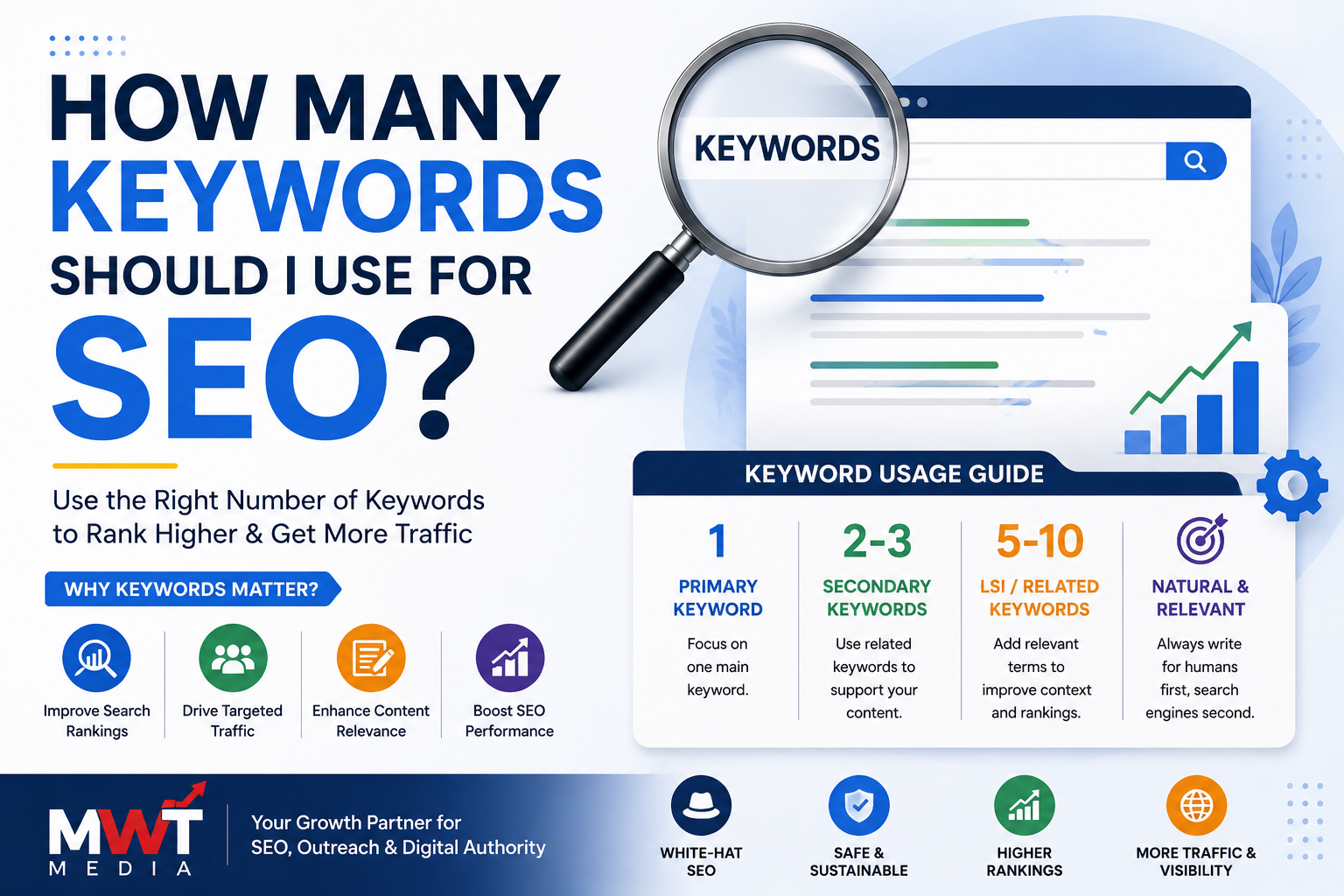
If you’ve typed “how many keywords should I use for SEO” into Google, you’ve probably found a dozen different answers — some say one, some say ten, some throw out vague advice like “as many as fit naturally.” The truth in 2026 is more nuanced than a single number, and it has a lot to do with how Google’s algorithms have evolved over the past few years.
This guide breaks down exactly how many keywords you should target per page, how Google’s latest updates have changed the rules, and how to build a keyword strategy that actually works — without falling into old-school keyword stuffing habits.
The Short Answer
For most pages, the ideal approach is:
- 1 primary keyword per page (your main focus)
- 3 to 10 secondary/semantic keywords that support the same topic and intent
- For longer, in-depth content (1,500+ words), this can stretch to 10–15 related terms
There’s no strict cap enforced by Google, but the practical guideline most SEOs agree on in 2026 is to keep everything on a page tightly clustered around one core topic and one core intent — rather than trying to rank one page for multiple unrelated queries.
Why “How Many Keywords” Is the Wrong Question (Sort Of)
Google’s systems no longer match content to search queries based on exact keyword counts. Since the rollout of the Helpful Content System and ongoing core updates, Google evaluates whether content is genuinely useful and written for people — not for search engines. Pages that repeat a keyword unnaturally, or try to cram in unrelated terms to “cover more searches,” risk being flagged as unhelpful, regardless of backlinks or domain authority.
So when people ask how many keywords should I use for SEO, the more accurate framing is: how thoroughly can you answer the query behind that keyword? A page that answers a question comprehensively — using natural variations, related terms, and supporting subtopics — will almost always outperform a page that repeats one exact phrase as many times as possible.
Primary vs. Secondary vs. Long-Tail Keywords
To build a proper keyword strategy, it helps to separate keywords into three categories:
1. Primary keyword The one main phrase your page is built around. This should appear in your title, H1, URL, meta description, and naturally throughout the body — ideally 2–3 times per 500 words, without forcing it.
2. Secondary keywords Closely related terms and variations that support the same topic. These help Google (and increasingly, AI search systems) understand the full context of your content without needing to repeat the primary keyword over and over. Think of these as the vocabulary a genuine expert on the topic would naturally use.
3. Long-tail keywords Longer, more specific phrases with lower search volume but higher intent — often the exact questions people type into Google. A well-optimized page can rank for its primary keyword and several long-tail variations, as long as they share the same underlying search intent.
Keyword Count by Content Length
The number of keywords you can naturally support depends heavily on how much content you’re producing:
| Content Type | Word Count | Suggested Keywords |
|---|---|---|
| Short landing page | 300–600 words | 1 primary + 1–2 secondary |
| Standard blog post | 800–1,200 words | 1 primary + 3–5 secondary |
| In-depth guide | 1,500–2,500 words | 1 primary + 8–15 secondary/long-tail |
| Pillar page / resource hub | 2,500+ words | 1 primary + 15+ related terms, organized by subtopic |
The more comprehensive the content, the more naturally related terms it can support — as long as every keyword still ties back to the same core topic and reader intent.
What Google’s Latest Updates Mean for Keyword Strategy
A few developments from Google’s recent algorithm updates directly affect how you should think about keyword usage:
People-first content is non-negotiable. Google’s Helpful Content guidance explicitly targets content that appears to be written primarily to rank for keywords rather than to help a reader. Keyword density that feels forced is now a liability, not an asset.
Keyword cannibalization is a real risk. Targeting the same primary keyword across multiple pages can cause your own pages to compete against each other in search results, diluting rankings for all of them. Map one primary keyword to one page.
Semantic and topical relevance matter more than exact-match repetition. Google’s language models understand synonyms, related concepts, and context — meaning you no longer need to repeat an exact phrase to rank for it. Natural variations and related terms often perform better than rigid repetition.
AI Overviews and AI search visibility reward topical depth. With more searches being answered directly by AI-generated summaries, pages that comprehensively cover a topic — rather than narrowly targeting one keyword — are more likely to be cited as a source in AI Overviews and tools like ChatGPT or Perplexity.
The meta keywords tag is dead. It’s been ignored by Google for years and has no bearing on rankings. Focus your keyword effort on the title tag, meta description, headers, and body content instead.
How to Build Your Keyword List the Right Way
- Start with one clear topic and search intent. Is the reader looking to learn, compare, or buy?
- Identify your primary keyword using tools like Google Keyword Planner, Ahrefs, or Semrush.
- Cluster related terms around that topic — synonyms, related questions, and long-tail variations that share the same intent.
- Map keywords to pages, not the other way around. Avoid assigning the same primary keyword to two different pages.
- Write for the reader first, then check that your primary and secondary keywords appear naturally in the title, headers, and body.
Common Keyword Mistakes to Avoid
- Keyword stuffing — repeating a phrase unnaturally in an attempt to boost rankings, which now actively hurts pages under Google’s Helpful Content System.
- Targeting unrelated keywords on one page — mixing informational and transactional intent confuses both readers and search engines.
- Duplicating primary keywords across multiple pages — this causes cannibalization and splits your ranking potential.
- Ignoring search intent — using a keyword without checking what type of content currently ranks for it (guide vs. product page vs. comparison, for example).
Final Answer: How Many Keywords Should I Use for SEO?
There’s no universal magic number. The most reliable approach in 2026 is to build each page around one primary keyword, supported by a handful of closely related secondary and long-tail terms, scaled to the depth of your content. The real goal isn’t hitting a specific keyword count — it’s covering a topic thoroughly enough that your page becomes the best possible answer to the reader’s question, for both traditional search and AI-driven search tools.