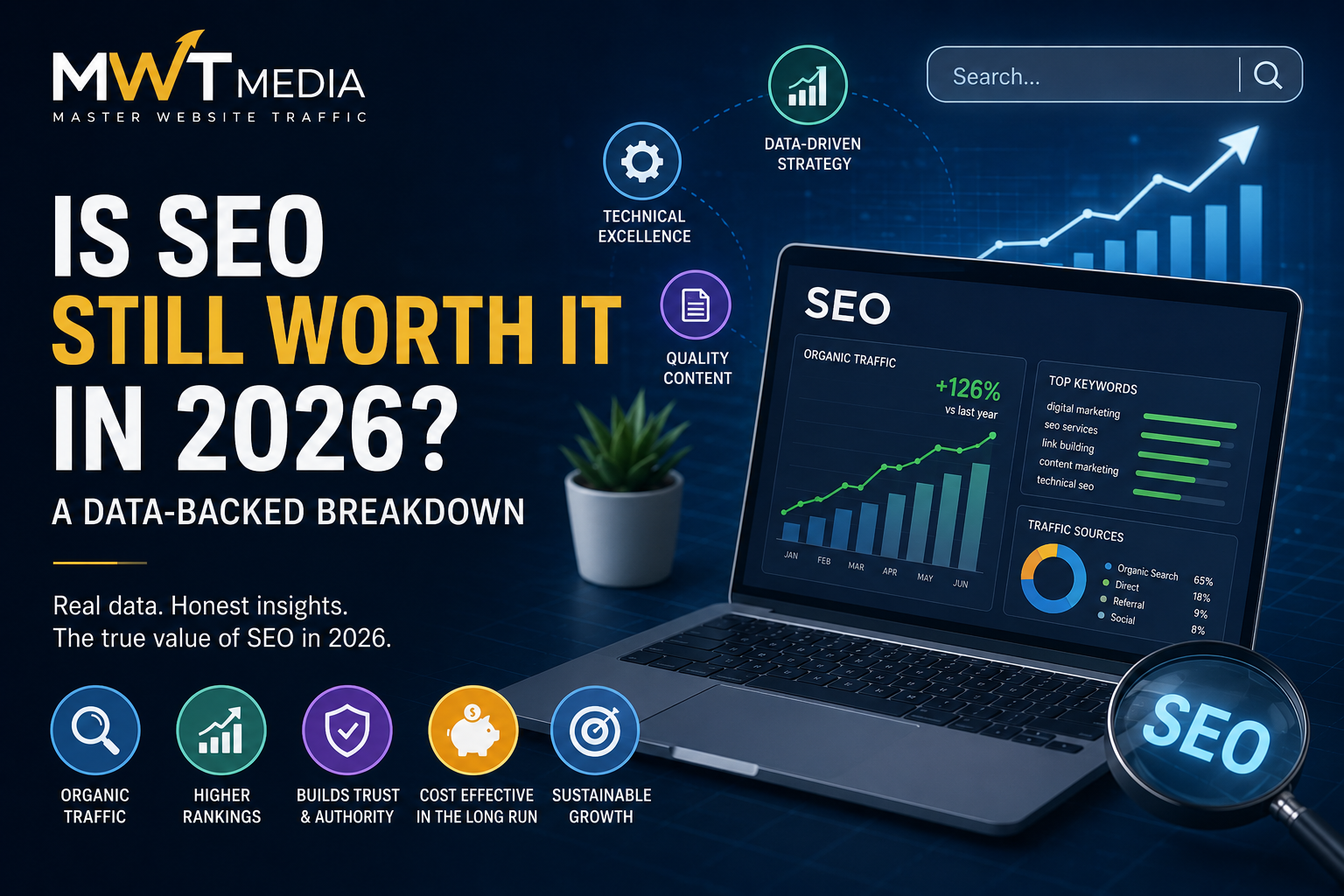
If you’ve been running ads, posting on social media, and maybe dabbling in SEO on the side, you’ve probably asked yourself: is SEO worth it anymore? Between AI-generated search summaries, shifting algorithms, and rising competition, it’s a fair question — and one that deserves an honest, numbers-driven answer rather than a sales pitch.
At MWT Media, we work with businesses asking this exact question every week. Short answer: yes, SEO is still worth it for most businesses in 2026 — but the way you approach it has changed. Let’s break down why.
Why People Are Questioning Whether SEO Is Worth It
A few real shifts are driving the doubt:
- AI Overviews and chat-based search now answer many queries directly, so fewer clicks reach websites for simple, informational questions.
- Competition has intensified. More businesses than ever are investing in content and technical SEO, making it harder to rank with thin or generic pages.
- Results take time. Unlike paid ads, SEO doesn’t deliver traffic overnight, which makes it feel risky compared to channels with instant, measurable output.
These are legitimate concerns. But they don’t mean SEO has stopped working — they mean the bar for doing it well has gone up.
The Case For: Why SEO Is Worth the Investment
1. Organic Traffic Is Still a Massive Channel
- Search remains one of the largest sources of website traffic across industries. Even with AI summaries answering simple questions, users still click through for comparisons, reviews, pricing, and anything requiring judgment or trust — exactly the kind of content SEO is built to capture.
2. It’s a Compounding Asset, Not a Rented One
- Paid ads stop the moment you stop paying. A well-optimized page, on the other hand, can keep generating traffic and leads for years with only maintenance-level effort. This compounding effect is one of the strongest arguments that SEO is worth it long-term, even if the upfront cost feels high.
3. Lower Cost Per Acquisition Over Time
- While SEO requires upfront investment (content, technical work, sometimes tools or a specialist), the cost per lead typically drops significantly after the first 6–12 months compared to running ads indefinitely at the same volume.
4. It Builds Trust and Authority
- Ranking organically signals credibility. Many buyers still perceive organic results as more trustworthy than paid ads, particularly in B2B, healthcare, finance, and other high-consideration purchases.
5. It Supports Every Other Channel
- Good SEO content strengthens your paid campaigns, social proof, and even sales conversations by giving you a library of authoritative, findable content to point people to.
The Case Against: When SEO Might Not Be Worth It
To be fair, SEO isn’t the right fit for everyone:
- Very early-stage startups that need immediate revenue may get faster ROI from paid ads or outbound sales.
- Hyper-competitive, low-differentiation niches may require years of investment before seeing meaningful returns.
- Businesses without content or technical resources may struggle to execute SEO well, making it a poor use of a tight budget.
- Extremely short product lifecycles don’t leave enough time for SEO’s slower payoff curve to matter.
If your business fits one of these situations, it’s reasonable to deprioritize SEO — at least for now.
So, Is SEO Worth It in 2026? The Verdict
For most businesses with a website, real customers searching online, and at least a 6–12 month growth horizon, the answer to “is SEO worth it” is yes — but only if it’s done deliberately:
- Focus on search intent, not just keywords. Content needs to genuinely answer what people are looking for, not just repeat a phrase.
- Invest in technical health. Site speed, mobile experience, and crawlability still matter for both traditional rankings and AI search visibility.
- Build topical authority, not isolated blog posts. Depth and consistency beat one-off content.
- Track the right metrics — qualified traffic, conversions, and revenue — not just rankings.
- Be patient but not passive. Give it time, but review performance regularly and adjust.
Final Thoughts
SEO in 2026 isn’t dead — it’s different. The businesses asking “is SEO worth it?” and getting a “no” are usually the ones expecting fast, effortless results from minimal effort. The businesses getting a “yes” are the ones treating it as a long-term asset worth building properly.
If you’re willing to invest consistently and adapt to how search is evolving, SEO remains one of the most durable, cost-effective ways to grow visibility and revenue online. That’s exactly the approach MWT Media takes with every client — building SEO strategies designed for long-term, compounding results rather than quick wins that fade.