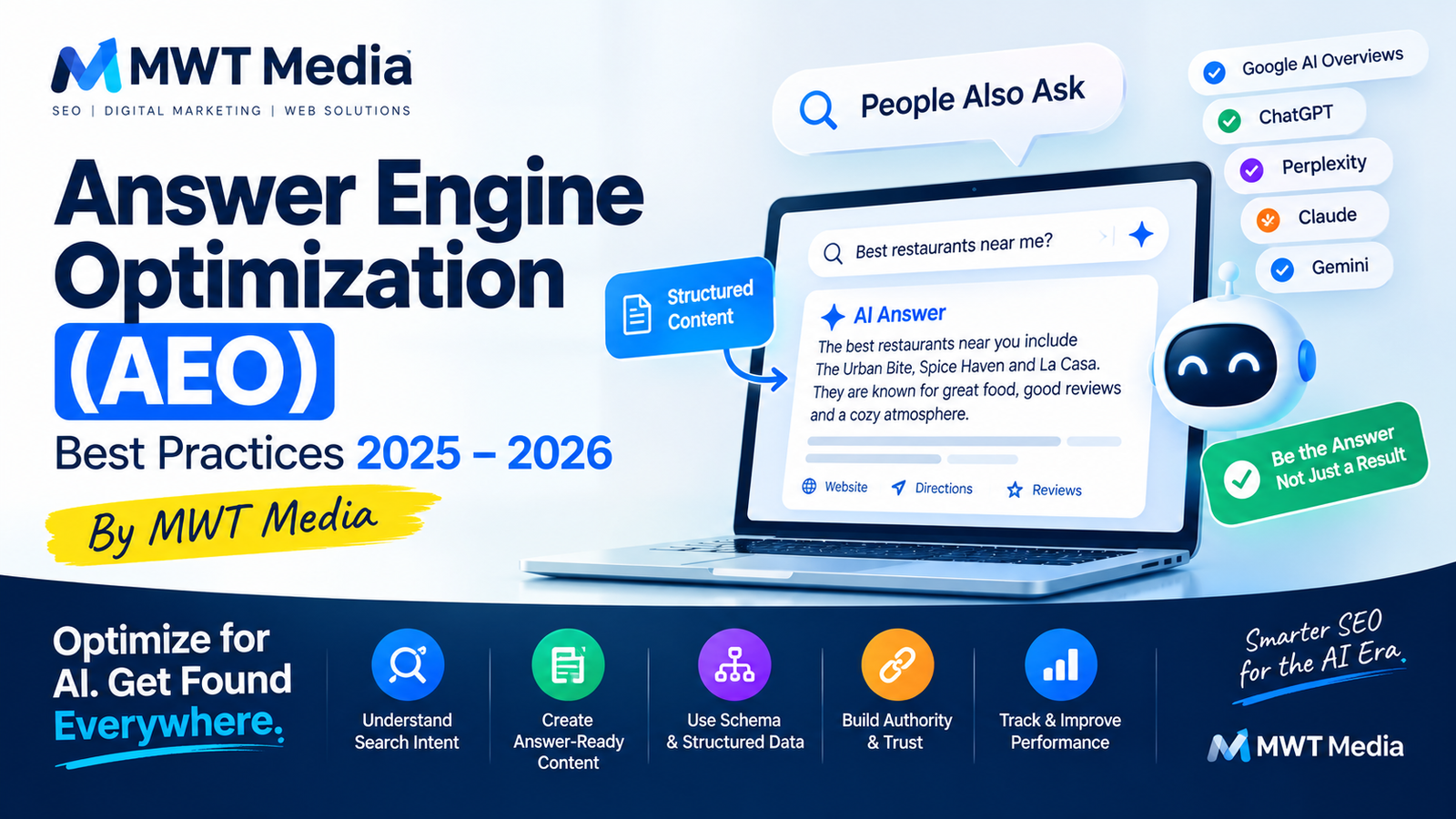
Search is changing. People no longer rely exclusively on traditional search results to find information, compare products, or choose a service provider. They increasingly ask AI-powered platforms such as ChatGPT, Google AI Overviews, Google AI Mode, and Perplexity to deliver direct answers, explain complex topics, and recommend solutions.
For businesses and content marketers, this shift creates a new opportunity: making website content useful not only for traditional search engines but also for AI-powered answer experiences.
This is where Answer Engine Optimization (AEO) comes in. AEO focuses on improving the way content answers user questions, communicates expertise, and provides reliable information that answer engines can discover and reference.
However, optimizing for AI search does not mean abandoning traditional SEO. Google’s official guidance confirms that established SEO practices remain important for visibility in its generative AI search features. Unique content, accessibility, technical quality, and a satisfying user experience continue to matter. Google Search Central
Whether you manage a business website, publish industry articles, or provide digital marketing services, understanding how AEO works can help you build a more effective content strategy for 2026.
What Is Answer Engine Optimization (AEO)?
Answer Engine Optimization is the process of improving website content so that search engines and AI-powered platforms can understand it, identify relevant information, and potentially reference it when responding to users’ questions.
Traditional SEO often focuses on improving organic search visibility and attracting visitors through search results. AEO builds on that foundation by placing greater emphasis on direct answers, conversational search queries, clear explanations, and trustworthy information.
For example, someone searching for an SEO agency might enter a short query such as “best SEO agency.” Alternatively, they might ask an AI assistant, “How can a small business find an SEO agency that specializes in guest posting and link building?”
The second query provides more context. Content that explains the services, outlines the selection criteria, addresses common concerns, and supports its claims with evidence may be more useful for answering that question.
AEO does not guarantee that a particular website will appear in an AI-generated response. Instead, it helps make content clearer, more relevant, and easier for search systems to evaluate and use.
Why AEO Matters in 2026
Search behavior is becoming increasingly conversational. Users expect quick explanations, practical recommendations, and answers tailored to their circumstances. AI-powered search experiences can combine information from multiple sources, giving businesses new opportunities to reach potential customers.
Several factors make AEO an important consideration for modern content strategies.
1. Search journeys are becoming more conversational
Users increasingly ask detailed questions instead of relying only on short keywords. Their queries may include a budget, location, specific requirements, or a comparison between several options.
Content that addresses these details can serve a wider range of relevant search intents without requiring a separate page for every minor keyword variation.
2. Brand visibility extends beyond traditional rankings
A business can build awareness when its expertise, products, or published resources are referenced in an AI-generated answer. Such visibility may introduce the brand to potential customers before they visit its website.
However, a brand mention does not automatically translate into website traffic or sales. Businesses should measure AI visibility alongside referral visits, leads, conversions, and other meaningful outcomes.
3. Clear and credible information is increasingly valuable
Answer engines need relevant information to respond to users’ questions. Pages that explain a topic accurately, provide supporting evidence, and communicate their purpose clearly offer more value than generic content written primarily to target keywords.
4. Traditional SEO remains essential
AEO is not a replacement for technical SEO, quality content, or a well-organized website. Search systems still need to discover and access relevant information, and Google’s AI search guidance emphasizes the continuing importance of established SEO fundamentals.
For this reason, businesses should integrate AEO into their existing SEO strategies rather than treating it as an entirely separate discipline.
Answer Engine Optimization AEO Best Practices 2025 2026: 10 Strategies to Follow

If you are researching answer engine optimization aeo best practices 2025 2026, the most useful approach is to focus on practical improvements that support both human readers and search systems. The following strategies provide a framework for creating content that answers questions effectively while maintaining strong SEO fundamentals.
1. Understand the Questions Your Audience Actually Asks
Effective AEO begins with understanding what your audience wants to know. Traditional keyword research identifies search terms, but content planning should also explore the problems, comparisons, and decisions behind those terms.
Start by reviewing Google Search Console queries, customer emails, sales conversations, support tickets, online discussions, and competitor content. These sources can reveal the questions people ask before making a purchase or choosing a service.
For an SEO agency, relevant questions might include:
- What is answer engine optimization, and how does it work?
- How can businesses improve visibility in AI search results?
- What is the difference between AEO, SEO, and generative engine optimization?
- How can small businesses optimize content for ChatGPT and Google AI Overviews?
- Does link building still matter for AI search visibility?
Group related questions according to search intent. Informational questions may require detailed guides, while commercial queries may be better served by comparison pages, service descriptions, and case studies.
The objective is not to publish a separate article for every question. Instead, develop comprehensive resources that address closely related questions naturally and provide enough detail to satisfy the reader.
2. Answer the Main Question Early
Readers should not have to navigate several paragraphs of background information before discovering the answer they came for.
Start each major section with a concise explanation, then expand on it with examples, supporting evidence, and practical recommendations. This structure makes content easier to scan and helps readers understand the main point quickly.
For example:
Question: What is Answer Engine Optimization?
Direct answer: Answer Engine Optimization (AEO) is the practice of improving website content so that search engines and AI-powered platforms can understand, retrieve, and potentially reference it when answering users’ questions.
The following paragraphs can explain how AEO differs from traditional SEO, why it matters, and how businesses can implement it.
This approach is particularly useful for definition-based queries, instructional content, and frequently asked questions. Nevertheless, concise answers should not come at the expense of accuracy or important context.
3. Structure Content with Clear Headings
A well-organized article makes it easier for readers to find information and understand how different ideas relate to one another.
Use one clear H1 heading for the main topic, followed by descriptive H2 headings for major sections and H3 headings for supporting points. Choose headings that accurately describe the content beneath them.
For example, an article about AEO might include sections such as:
- What Is Answer Engine Optimization?
- How Does AEO Differ from Traditional SEO?
- Which Content Formats Support AEO?
- How Can You Measure AI Search Visibility?
- What AEO Mistakes Should Businesses Avoid?
Use short paragraphs, numbered steps, bullet points, and tables where they genuinely improve readability.
Avoid forcing keywords into every heading. A heading should help the reader understand what comes next, not simply repeat the target phrase.
4. Create Original, Experience-Based Content
One of the strongest ways to differentiate your content is to provide information that readers cannot easily find in dozens of competing articles.
Generic explanations of AEO are widely available. Publishing another article that repeats familiar advice without adding meaningful value is unlikely to establish a strong competitive advantage.
Instead, include practical examples, original observations, expert commentary, documented results, and lessons learned from real projects.
For example, an agency could explain how it audited a client’s service pages, identified unclear descriptions, improved internal linking, and monitored changes in relevant search queries. Where appropriate, it could share anonymized performance data and explain the limitations of the findings.
Useful ways to strengthen originality include:
- Add firsthand insights from actual projects.
- Support factual claims with reliable, relevant sources.
- Explain why a recommendation works and when it might not.
- Include original research, examples, or meaningful comparisons.
- Update outdated information and correct unsupported claims.
Google’s guidance for generative AI search specifically emphasizes helpful, unique, non-commodity content. The goal should be to give readers something valuable rather than simply repackage information that already exists elsewhere.
5. Optimize for Conversational and Long-Tail Queries
People often interact with answer engines using complete questions or detailed prompts. Your content strategy should account for these natural-language searches while remaining focused on genuine audience needs.
Consider a broad keyword such as “technical SEO.” It may represent several different intents, including learning the basics, finding an audit checklist, troubleshooting indexing problems, or hiring a specialist.
A more focused article could answer questions such as:
- How do you identify indexing problems on a WordPress website?
- Which technical SEO issues should be fixed first?
- How can a business check whether important pages are accessible to search engines?
- What should a technical SEO audit include?
Use keyword research tools, Search Console data, customer feedback, and relevant industry discussions to identify these opportunities.
Then incorporate the questions into the most appropriate sections of your content. Avoid creating large numbers of nearly identical pages solely to target minor wording variations. A comprehensive resource that genuinely addresses a topic is often more useful than a collection of repetitive articles.
6. Strengthen E-E-A-T and Content Credibility
Experience, expertise, authoritativeness, and trustworthiness—commonly referred to as E-E-A-T—provide a useful framework for evaluating content quality, particularly when accuracy matters.
Although E-E-A-T is not a single ranking factor that guarantees visibility, demonstrating credibility helps readers assess whether your information deserves their attention.
Practical improvements include:
- Publish content under identifiable authors with relevant experience.
- Include accurate author biographies and editorial information.
- Cite original research, official documentation, and reliable sources.
- Keep statistics, product information, and time-sensitive claims current.
- Explain methods and limitations when presenting case studies.
- Maintain consistent and accurate business information across your website.
For example, an article discussing AI search optimization should distinguish official search-engine guidance from industry opinions and experimental tactics. If a technique has not been proven to improve visibility, present it as a hypothesis or optional experiment rather than a guaranteed solution.
Trust is built through accuracy, transparency, and useful information—not exaggerated claims about ranking in AI answers.
7. Use Structured Data Where It Helps
Structured data is a standardized way to describe information on a webpage so that search engines can better understand its content. Depending on the page, relevant schema types may include Article, Organization, Person, Product, and LocalBusiness.
For example, an agency website can use Organization schema to describe its business, while an educational blog post may benefit from Article schema that identifies the headline, author, and publication dates.
When implementing structured data:
- Choose schema types that accurately reflect the page.
- Ensure the markup matches the visible content.
- Validate the implementation using Google’s Rich Results Test and Schema Markup Validator.
- Keep important business details consistent and accurate.
- Monitor relevant errors in Google Search Console.
It is important to understand that structured data does not guarantee inclusion in AI-generated answers. Google’s guidance also makes clear that special AI-specific markup is not required for appearing in its AI search features.
Use schema to communicate genuine information more clearly, not as a shortcut to AI visibility.
8. Improve Technical SEO and Crawlability
Even excellent content has limited search value if search systems cannot access it properly. Technical SEO therefore remains an essential part of any AEO strategy.
Start by checking whether important pages can be crawled and indexed. Review your robots.txt file, meta robots directives, canonical tags, XML sitemap, internal links, and HTTP response codes.
Pay particular attention to the following areas:
Indexability: Make sure important content is not accidentally blocked from indexing.
Internal linking: Link related articles, service pages, and supporting resources using descriptive anchor text.
Canonicalization: Consolidate duplicate or near-duplicate URLs where appropriate so that search engines can identify the preferred version.
Mobile usability: Ensure the main content remains accessible and readable on mobile devices.
Page experience: Improve loading performance, reduce unnecessary interface elements, and make content easy to navigate.
JavaScript rendering: Verify that important content is available to search systems when your website relies on JavaScript.
For websites targeting multiple AI platforms, review their published documentation and crawler requirements. Do not assume that access granted to one crawler automatically guarantees access to every platform.
Technical accessibility does not guarantee that a page will be cited, but it helps remove barriers that could prevent relevant content from being discovered.
9. Build Brand Authority Beyond Your Website
Answer engines may use information from multiple sources when evaluating a business, product, or topic. Maintaining a credible presence beyond your own website can therefore support your broader digital marketing strategy.
Focus on earning legitimate mentions, relevant editorial coverage, industry partnerships, expert contributions, and links from websites that serve your target audience.
For example, an SEO agency could contribute an original article to a reputable digital marketing publication, publish a useful research report, or share practical insights that industry professionals reference in their own work.
Guest posting and link building can support this process when they prioritize editorial relevance, useful content, and genuine relationships. However, purchasing placements simply to manufacture authority or relying on large volumes of low-quality backlinks is not a dependable AEO strategy.
Also ensure that your business information remains accurate across relevant directories, professional profiles, and industry publications.
The objective is to establish a consistent, credible digital footprint. No particular backlink metric, domain authority score, or number of brand mentions guarantees that an AI platform will recommend your business.
10. Measure AEO Performance and Improve Continuously
AEO should be treated as an ongoing optimization process rather than a one-time content update.
Start by establishing a baseline for your website’s existing search performance. Then monitor relevant metrics and test whether your improvements lead to meaningful changes.
Useful measurement methods include:
| Metric | What It Helps You Understand |
|---|---|
| Organic impressions and clicks | Whether traditional search visibility is improving |
| Relevant search queries | Which questions and topics bring users to your website |
| AI referral traffic | Whether identifiable AI platforms send visitors to your website |
| Brand mentions in AI answers | How often your business appears in a defined set of relevant prompts |
| Source citations | Whether your pages are cited or linked in sampled AI responses |
| Conversions and qualified leads | Whether visibility contributes to business outcomes |
| Content engagement | Whether visitors find your pages useful after arriving |
To measure AI visibility, create a consistent list of prompts that reflect the questions your customers ask. Test those prompts across relevant platforms at regular intervals and record the date, response, brand mentions, cited sources, and competitors mentioned.
Because AI responses can vary by session, location, personalization, and platform updates, avoid drawing conclusions from a single test. Compare repeated observations over time.
Google Search Console remains useful for monitoring traditional search performance. Use available analytics and referral data to investigate traffic from AI platforms, recognizing that not every AI-assisted discovery journey will be identifiable in your reports.
The aim is to connect visibility improvements with measurable business value rather than focusing exclusively on mentions or rankings.
AEO Content Optimization Checklist for 2026
Before publishing or refreshing an article, use this practical checklist to review its readiness.
The page addresses a clearly defined audience and search intent.
The introduction explains the main topic without unnecessary filler.
The main question receives a direct, accurate answer.
Headings describe the content beneath them.
Supporting questions are covered where relevant.
Claims are supported by reliable sources or firsthand evidence.
Examples provide practical value beyond generic advice.
The content includes relevant internal and external links.
Images include descriptive alternative text where appropriate.
Relevant structured data is implemented correctly.
Canonical tags, indexing directives, and internal links are reviewed.
The page works well on mobile devices.
The author and business information are accurate.
Performance and conversions can be monitored after publication.
Not every item applies to every page. Prioritize improvements according to the content type, technical requirements, audience needs, and business objectives.
Common AEO Mistakes to Avoid
Even a well-planned strategy can become ineffective when optimization focuses on shortcuts instead of user needs.
Keyword stuffing
Repeating phrases such as “answer engine optimization” or “AEO best practices” unnaturally makes content harder to read. Use your primary keyword where it fits, then rely on relevant terminology and clear explanations throughout the article.
Publishing generic AI-generated content
AI tools can help with research, outlining, and editing, but they should not replace fact-checking, subject expertise, or original insights. Review every important claim and add meaningful value before publication.
Assuming FAQ sections guarantee AI citations
Frequently asked questions can help address user concerns, but adding an FAQ section does not automatically increase the likelihood of appearing in AI answers. Include questions when they genuinely help readers.
Overusing structured data
Adding irrelevant schema types or marking up information that does not appear on the page can create errors and misleading signals. Use only appropriate markup.
Treating backlinks as a guaranteed ranking shortcut
Backlinks can contribute to a broader SEO strategy, but no particular link-building campaign guarantees AI citations. Focus on relevance, editorial quality, and a strong overall website.
Ignoring performance measurement
Publishing content without monitoring its results makes it difficult to identify what is working. Establish a baseline, record changes, and review outcomes consistently.
What Is the Difference Between AEO, SEO, and GEO?
These terms overlap, but each emphasizes a slightly different aspect of search visibility.
| Approach | Primary Focus |
|---|---|
| Search Engine Optimization (SEO) | Improving visibility in traditional search results and supporting organic website traffic |
| Answer Engine Optimization (AEO) | Making content useful and accessible for systems that provide direct answers |
| Generative Engine Optimization (GEO) | Improving visibility and representation within generative AI responses |
In practice, many of the same activities support all three approaches: creating useful content, maintaining technical accessibility, establishing credibility, and clearly communicating relevant information.
The terminology is still evolving, and businesses do not necessarily need three separate strategies. A coordinated approach that combines strong SEO fundamentals with clear, question-focused content is a practical starting point.
How Businesses Can Implement an AEO Strategy
Businesses do not need to overhaul their entire website to begin optimizing for answer engines. A phased approach helps prioritize the work and makes progress easier to evaluate.
Phase 1: Audit existing content. Identify important service pages, educational resources, and articles that already receive search impressions. Look for unanswered questions, outdated information, technical issues, and opportunities to add original insights.
Phase 2: Improve high-priority pages. Rewrite unclear introductions, strengthen headings, add relevant examples, improve internal links, and ensure the main question receives a useful answer.
Phase 3: Address technical barriers. Review crawlability, indexing, canonicalization, mobile usability, and structured data where relevant.
Phase 4: Strengthen authority. Publish original resources, earn relevant editorial mentions, and maintain accurate business information across appropriate platforms.
Phase 5: Measure and refine. Track organic performance, identifiable AI referrals, sampled brand mentions, citations, and conversions. Use the findings to prioritize the next round of improvements.
This approach allows marketing teams to integrate AEO into existing workflows without treating every new AI platform as a separate optimization project.
Final Thoughts
Optimizing content for answer engines in 2026 requires a combination of useful information, clear writing, technical accessibility, credible expertise, and consistent measurement. There is no single formatting trick, schema type, or backlink tactic that guarantees visibility in AI-generated responses.
The most effective strategy is to understand your audience’s questions and answer them better than competing resources. Support those answers with evidence, maintain a technically sound website, and give readers a reason to trust your expertise.
When applying answer engine optimization aeo best practices 2025 2026, remember that sustainable visibility comes from building on established SEO principles rather than chasing unverified shortcuts. As AI-powered search continues to evolve, businesses that prioritize accuracy, originality, and genuine usefulness will be better positioned to adapt.
Frequently Asked Questions
What are the best AEO practices for 2026?
The most useful practices include answering questions directly, publishing original and reliable content, using clear headings, maintaining technical SEO, implementing relevant structured data, building genuine brand authority, and monitoring AI search visibility alongside traditional SEO performance.
How do I optimize content for AI answer engines?
Start by identifying the questions your audience asks. Provide a direct answer near the beginning of relevant sections, explain the topic with supporting details, cite trustworthy sources, use descriptive headings, and ensure search systems can access the page.
Is AEO different from traditional SEO?
AEO places additional emphasis on making content suitable for direct answers and AI-powered search experiences. However, it builds on many established SEO practices, including helpful content, crawlability, internal linking, and technical quality.
Does schema markup improve AEO?
Relevant schema markup can help search engines understand specific information on a page. However, it does not guarantee that a page will appear in AI-generated responses. Implement structured data accurately and follow the applicable platform documentation.
Can backlinks help with answer engine optimization?
Relevant, editorially earned backlinks can support overall SEO and help people discover credible resources. However, there is no universal backlink threshold or guaranteed link-building method for securing AI citations.
How can I track AEO results?
Monitor organic search performance, identifiable AI referral traffic, brand mentions, source citations, and conversions. Use a consistent set of relevant prompts to assess visibility across selected platforms over time, and interpret the results alongside other marketing data.