B2B SaaS buyers rarely make purchasing decisions after reading a single webpage. They research software features, compare competing platforms, evaluate integrations, explore pricing models, and look for evidence that a solution can solve their specific business problems. Increasingly, they also use AI-powered search experiences to summarize options and answer detailed questions before speaking with a sales team.
This shift creates a new challenge for SaaS marketers: how can they make their content useful not only for traditional search engines but also for answer engines that generate responses using information from multiple sources?
Answer Engine Optimization (AEO) offers a practical approach. It focuses on making content clear, relevant, accessible, and useful for systems that answer user questions. For B2B SaaS companies, this means organizing product information, educational resources, comparison pages, and technical documentation around the questions buyers actually ask.
However, AEO is not simply about adding FAQs to every page or inserting keywords into headings. Effective optimization requires a well-planned content architecture, credible information, strong technical SEO, and a clear understanding of the B2B buying journey.
This guide explores AEO Content structure for b2b saas platforms and explains ten practical ways to organize SaaS content for better discoverability, stronger buyer engagement, and improved visibility across AI-powered search experiences in 2026.
What Is AEO Content Structure for B2B SaaS Platforms?
AEO content structure for B2B SaaS platforms refers to the way software companies organize and present information so that users, search engines, and AI-powered answer systems can understand their products, identify relevant details, and potentially reference their content when answering questions.
Unlike a content strategy that focuses exclusively on publishing blog posts around target keywords, an AEO-oriented structure considers the entire information journey. It connects educational articles, product pages, feature descriptions, industry-specific use cases, integrations, pricing information, customer evidence, and support documentation.
Consider a company selling customer relationship management (CRM) software. A prospective buyer might ask an AI assistant:
“What is the best CRM for a small B2B sales team that integrates with HubSpot and supports automated lead scoring?”
A generic article about CRM software may not answer this question adequately. A stronger content ecosystem would include detailed integration documentation, an explanation of lead-scoring functionality, use cases for small sales teams, transparent pricing information, and relevant product comparisons.
Together, these resources provide a clearer picture of the product and help potential buyers evaluate whether it fits their requirements.
There is no guarantee that an AI platform will cite a particular page. Nevertheless, a well-structured content ecosystem makes information easier to navigate, verify, and understand.
Why AEO Matters for B2B SaaS Companies in 2026
B2B software purchases often involve several decision-makers, long evaluation periods, and detailed technical requirements. Buyers may move between educational research, vendor comparisons, security reviews, and pricing discussions before choosing a platform.
AI-powered search can influence these stages by helping prospects understand unfamiliar concepts, shortlist potential vendors, and compare product capabilities.
AEO matters for three important reasons.
It supports discovery during early research. Clear educational content can help prospects understand a problem before they begin evaluating specific software products.
It helps communicate product differentiation. Detailed feature pages, use cases, integration guides, and comparisons give buyers a more complete understanding of a platform’s capabilities.
It complements existing SEO efforts. Search engines still need to discover and access relevant pages. Technical SEO, helpful content, internal linking, and credible information remain important foundations.
Google’s official guidance on AI features in Search emphasizes that established SEO fundamentals continue to apply. Businesses do not need a separate set of special AI markup requirements to appear in Google’s AI search experiences.
For SaaS companies, the practical opportunity is to make their existing content more useful, specific, and logically connected.
10 AEO Content Structure Best Practices for B2B SaaS in 2026
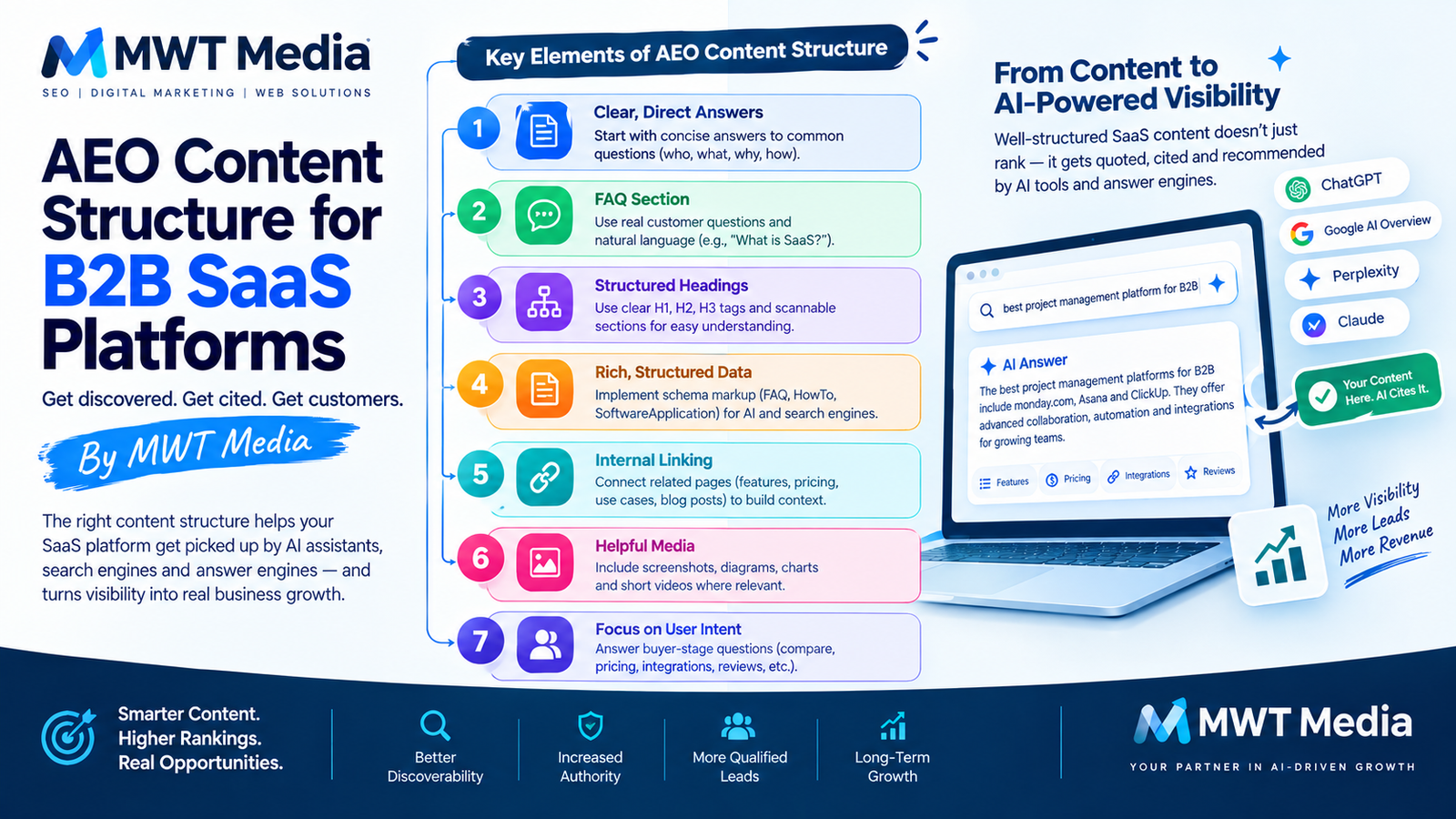
1. Organize Content Around the B2B Buyer’s Journey
One of the most common SaaS content problems is publishing articles without connecting them to the decisions buyers need to make. A blog might explain a general industry concept, while the product pages describe features using entirely different terminology.
An effective AEO strategy connects these resources through a logical content structure that reflects the buyer’s journey.
Start by grouping content into three broad stages.
Awareness stage: Help readers understand a problem, industry trend, or business challenge. Topics might include workflow automation, customer retention, or sales pipeline management.
Consideration stage: Explain potential solutions, methodologies, and product categories. Useful resources include implementation guides, feature comparisons, and software selection checklists.
Decision stage: Help buyers evaluate your specific platform. Relevant content includes product pages, pricing, integration documentation, security information, customer case studies, and demonstrations.
For example, a project management SaaS company could connect an article about remote team productivity to a guide comparing project management methods, then link that guide to its task automation feature page.
This structure helps users move naturally from learning about a problem to evaluating a solution. It also creates meaningful relationships between related pages rather than leaving individual articles isolated.
2. Build Dedicated Pages for Core Product Features
Product features are central to SaaS buying decisions, yet some companies describe every capability on a single, lengthy product page. This can make it difficult for buyers to find specific information about the functionality they need.
Where the product’s complexity and search demand justify it, create dedicated pages for major features.
A marketing automation platform, for example, might have separate pages for:
- Email campaign automation
- Lead scoring and qualification
- Customer segmentation
- Marketing analytics and reporting
- CRM integrations
- Workflow automation
Each page should explain what the feature does, which problem it solves, how it works, who benefits from it, and what limitations or requirements buyers should understand.
A consistent structure might include a short definition, key capabilities, practical use cases, implementation details, relevant integrations, and links to related resources.
Avoid creating separate pages for every minor feature variation. If two pages would contain substantially the same information, combining them may provide a better experience.
The objective is to make important product capabilities easy to understand without fragmenting the website into repetitive, low-value content.
3. Start Each Section with a Direct, Useful Answer
B2B buyers often have specific questions and limited time. When an article or product page takes too long to address the main question, readers may struggle to find the information they need.
Begin important sections with a concise answer, then provide supporting details, examples, and relevant qualifications.
For instance:
Question: What is automated lead scoring in B2B SaaS?
Automated lead scoring assigns scores to potential customers based on defined characteristics and behaviors, helping sales and marketing teams prioritize leads. Depending on the platform, scoring criteria may include job role, company attributes, website activity, email engagement, and other qualification signals.
The following paragraphs can explain how the scoring model works, which data sources it uses, and how teams can configure thresholds.
This approach provides immediate clarity without sacrificing depth.
Use direct-answer formatting for definitions, feature explanations, implementation questions, and comparisons. Keep the information accurate and specific to the product or subject being discussed.
Do not assume that a short answer automatically improves AI visibility. Its main purpose is to help readers understand the information efficiently, while the supporting explanation establishes context and usefulness.
4. Create Comparison Pages That Address Real Buying Questions
Comparison searches are particularly valuable in B2B SaaS because buyers often have a shortlist before contacting sales representatives.
They may compare your product with a competitor, evaluate two different software categories, or investigate whether a specialized tool is better suited to their business.
Create comparison content that addresses genuine evaluation criteria rather than simply claiming that your product is superior.
Useful comparison pages can cover:
- Core features and functional differences
- Pricing models and contract requirements
- Integration availability
- Implementation complexity
- Security and compliance capabilities
- Support options
- Ideal company size or use case
- Important limitations and trade-offs
For example, a SaaS company offering customer support software could publish a comparison explaining how live chat, help desk software, and customer service automation differ.
When comparing named competitors, verify the information, identify the date of review where appropriate, and distinguish confirmed facts from subjective assessments.
Avoid misleading comparison tables, unsupported performance claims, and outdated competitor details. Buyers need credible information to make decisions, and transparent comparisons can build trust even when the content acknowledges situations in which another product may be a better fit.
5. Develop Industry-Specific Use Case Pages
B2B SaaS platforms frequently serve multiple industries, departments, or business models. A single general product page may not explain how the software addresses the distinct needs of each audience.
Industry-specific use case pages can bridge this gap when they offer genuinely different information.
For example, a workflow automation platform might serve healthcare administrators, financial services teams, manufacturing companies, and software businesses. Each audience has different processes, terminology, operational requirements, and implementation concerns.
A useful industry page should explain:
- The specific problem faced by that audience
- How the product addresses the problem
- Relevant workflows and features
- Applicable integrations or implementation requirements
- Evidence from relevant customer projects, where available
- Limitations, compliance considerations, or other important qualifications
Use real customer examples and documented results when possible. If you cannot support an industry-specific performance claim, explain the potential benefit without inventing statistics.
Avoid producing dozens of nearly identical pages that change only the industry name. Each page should offer meaningful value to its intended audience and provide a clear reason to exist.
6. Structure Integration Pages Around Specific Technical Questions
Integrations are an important part of SaaS purchasing decisions. Buyers want to know whether a platform works with their existing software, what information can be synchronized, and how much effort implementation will require.
Instead of listing every integration on a single page, consider creating dedicated pages for significant integrations when they serve distinct user needs.
A useful integration page should explain:
- Which products or systems can connect
- What data can be transferred or synchronized
- Whether the integration works in real time or on a schedule
- How authentication and configuration work
- Whether a native integration, API, or third-party connector is required
- Which permissions, subscription plans, or technical prerequisites apply
- How users can troubleshoot common issues
For example, a CRM platform could create a detailed page explaining how its Salesforce integration synchronizes contact records, manages duplicate entries, and supports sales reporting.
Include links to relevant setup instructions, API documentation, troubleshooting resources, and product features.
This approach makes integration information easier to navigate and helps technical evaluators determine whether the product meets their requirements. Keep the information current whenever integrations, APIs, or supported functionality change.
7. Use FAQ Sections to Address Specific Objections
Frequently asked questions can help SaaS companies address concerns that might otherwise delay a purchase. They are especially useful for explaining pricing, implementation, migration, security, compatibility, and ongoing support.
However, an FAQ section should not become a collection of loosely related questions added simply to increase keyword coverage.
Choose questions based on actual customer concerns, sales conversations, support tickets, and relevant search queries.
For a B2B SaaS platform, useful questions might include:
- How long does implementation typically take?
- Can existing customer data be migrated?
- Which integrations are included in the standard plan?
- Does the platform support role-based access control?
- What happens when a subscription is upgraded or downgraded?
- Can the software accommodate multiple business locations?
Provide a direct response to each question, followed by the qualifications or technical details needed for accuracy.
For example, if implementation time depends on the number of integrations and the complexity of data migration, explain those factors instead of promising a fixed timeline for every customer.
Place FAQs on the pages where the questions naturally arise. Product-related questions belong on product pages, while technical questions may be better suited to documentation or a support knowledge base.
FAQ content can improve the user experience, but it does not guarantee AI citations or special search visibility.
8. Build a Connected Knowledge Base and Documentation Hub
Technical documentation is often one of the most informative parts of a SaaS website. It explains how a product works, what it supports, and how users can resolve specific problems.
Yet documentation can become difficult to navigate when articles lack consistent headings, descriptive titles, or links to related resources.
Organize your knowledge base into logical categories such as:
- Getting started
- Account configuration
- Product features
- Integrations
- API documentation
- Data migration
- Security and permissions
- Troubleshooting
- Billing and subscription management
Give each article a specific purpose. A troubleshooting page should identify the problem, explain its likely causes, provide diagnostic steps, and describe the appropriate resolution.
For API documentation, include endpoint descriptions, authentication requirements, parameters, response formats, error codes, and working examples where applicable.
Use descriptive internal links to connect documentation with related features, setup instructions, and integration pages. Keep version-specific documentation clearly labeled so that developers do not accidentally follow outdated instructions.
Also verify that important documentation is accessible to the intended audience. Public resources and authenticated customer documentation may have different access requirements, so ensure that access controls are intentional rather than accidental.
A well-maintained knowledge base helps customers solve problems independently while providing a clear, organized source of product information.
9. Demonstrate Expertise Through Evidence and Original Insights
AEO content structure is not only about page layouts. The quality of the information itself matters.
B2B buyers evaluate risk as well as functionality. They want evidence that a software vendor understands their challenges and can deliver the capabilities it advertises.
Strengthen content with documented customer results, expert explanations, original research, product demonstrations, and transparent technical details.
For example, a cybersecurity SaaS provider could publish a case study describing a customer’s previous security workflow, the implementation process, the controls introduced, and the measured results.
A credible case study should explain how the results were measured and identify relevant limitations. If a customer reduced manual work by a particular percentage, provide enough context to show how that figure was calculated.
Other ways to demonstrate expertise include:
- Publishing detailed implementation guides.
- Explaining technical trade-offs and product limitations.
- Providing original benchmark data with a clear methodology.
- Including meaningful expert commentary.
- Maintaining accurate author biographies and editorial standards.
- Citing official documentation for technical and regulatory claims.
Google’s people-first content guidance emphasizes helpful, reliable information created for users. Although credibility does not guarantee inclusion in an AI answer, it gives prospective buyers a stronger basis for evaluating your expertise.
10. Measure Content Performance and Refine Your Structure
AEO should be integrated into an ongoing measurement process. Without a baseline and consistent reporting, it is difficult to distinguish meaningful improvements from normal fluctuations in search and AI-generated responses.
Start by identifying the pages that matter most to the business. These may include high-value product pages, integration guides, comparison articles, industry use cases, and technical documentation.
Track performance across several dimensions.
| Metric | Why It Matters |
|---|---|
| Organic impressions and clicks | Shows changes in traditional search visibility |
| Relevant search queries | Reveals the questions associated with your pages |
| AI referral sessions | Identifies measurable visits from AI platforms |
| Brand mentions in AI answers | Tracks visibility across a defined set of prompts |
| Source citations | Shows whether your content is referenced in sampled answers |
| Demo requests and qualified leads | Connects content performance with the sales pipeline |
| Assisted conversions | Helps identify content involved in longer buying journeys |
| Engagement and navigation | Indicates whether users find and explore relevant information |
To evaluate AI visibility, develop a consistent set of prompts based on your customers’ real questions. Include product-related queries, industry problems, integration requirements, and competitor comparisons.
Record which brands and sources appear, whether your content is cited, and how responses change over time. Repeat the tests under reasonably consistent conditions because AI answers can vary by platform, date, location, and context.
Use Google Search Console to monitor traditional search performance and your analytics platform to investigate identifiable AI referral traffic. Remember that many AI-assisted discovery journeys will not be fully attributable.
Finally, prioritize changes according to business impact. Improving a high-intent product comparison page may be more valuable than rewriting a low-traffic informational article.
A Practical AEO Content Architecture for B2B SaaS
The ten best practices become easier to implement when they are organized into a coherent website structure.
A typical B2B SaaS content architecture could look like this:
<box border radius=”lg” padding={3} gap={2} align=”center”> <box background=”surface-secondary” radius=”md” padding={3} width=”100%” align=”center”> **Main Product Page**
<text color="secondary" size="sm" textAlign="center">Core value proposition, capabilities, and primary use cases</text></box> <icon name=”arrow-down” size=”lg” color=”secondary”/> <grid columns={2} gap={2}> <grid-item> <box border radius=”md” padding={2} gap={1} height=”100%”> **Feature Pages**
    <text size="sm" color="secondary">Individual capabilities, workflows, and benefits</text>
  </box>
</grid-item>
<grid-item>
  <box border radius="md" padding={2} gap={1} height="100%">
    **Use Case Pages**

    <text size="sm" color="secondary">Industry-specific problems and applications</text>
  </box>
</grid-item>
<grid-item>
  <box border radius="md" padding={2} gap={1} height="100%">
    **Comparison Pages**

    <text size="sm" color="secondary">Alternatives, evaluations, and buyer decisions</text>
  </box>
</grid-item>
<grid-item>
  <box border radius="md" padding={2} gap={1} height="100%">
    **Integration Pages**

    <text size="sm" color="secondary">Compatibility, setup, and technical requirements</text>
  </box>
</grid-item>
</grid> <icon name=”arrow-down” size=”lg” color=”secondary”/> <box background=”surface” border radius=”md” padding={3} width=”100%” align=”center”> **Supporting Resources**
<text size="sm" color="secondary" textAlign="center">Educational articles, FAQs, customer case studies, knowledge base, and API documentation</text></box> </box>
The main product page establishes the platform’s overall purpose. Supporting pages explain individual capabilities, audience-specific applications, integrations, and alternatives. Educational content and documentation answer more detailed questions and link users to the most relevant product resources.
This is a flexible framework, not a mandatory template. The right structure depends on your product complexity, customer needs, available resources, and existing website architecture.
The important principle is to make relationships between pages clear while ensuring every page serves a distinct purpose.
Common AEO Mistakes B2B SaaS Companies Should Avoid
Even a carefully planned content strategy can underperform when it prioritizes optimization tactics over usefulness.
Creating thin programmatic pages: Automatically generating hundreds of feature, integration, or industry pages with minimal differences can produce repetitive content. Publish a page only when it offers meaningful, specific information.
Making unsupported product claims: Statements about integrations, security certifications, performance, and functionality should be verified. Inaccurate claims can damage trust and create problems during procurement.
Ignoring technical accessibility: Important pages should be crawlable, indexable where appropriate, and connected through meaningful internal links. Review canonicalization and rendering issues before investing heavily in new content.
Overloading pages with FAQs: Include questions that address real user needs rather than repeating the same answers across every page.
Treating competitor comparisons as advertising: One-sided comparisons may fail to answer the questions buyers actually have. Provide accurate details, meaningful criteria, and relevant limitations.
Measuring only AI mentions: A brand mention can be useful, but it is not equivalent to a qualified lead or sale. Combine visibility metrics with engagement, conversions, and pipeline outcomes.
Assuming structured data guarantees AI visibility: Schema markup can clarify information for search systems, but it is not a substitute for strong content, technical accessibility, or a credible website.
Final Thoughts
For B2B SaaS companies, AEO is best approached as a content architecture and information-quality challenge rather than a collection of isolated SEO tactics.
Buyers need clear answers about product capabilities, integrations, pricing, implementation, security, and business value. Search engines and AI-powered platforms also need accessible, understandable information to evaluate and potentially reference relevant pages.
A strong content structure connects those needs. It gives every important page a clear purpose, organizes related resources logically, answers specific questions, and supports claims with credible evidence.
When implementing aeo content structure for b2b saas platforms, begin with the pages that influence discovery and purchasing decisions most directly. Improve product descriptions, create useful comparisons, strengthen integration documentation, connect related resources, and measure the results over time.
There is no guaranteed formula for appearing in AI-generated answers. However, a well-organized website with original, accurate, and genuinely helpful information provides a stronger foundation for traditional SEO, AI search discovery, and the B2B buying journey.
Frequently Asked Questions
What is the best content structure for AEO in B2B SaaS?
A practical structure includes a core product page supported by dedicated feature pages, industry-specific use cases, comparison pages, integration documentation, educational articles, and a knowledge base. Internal links should connect related resources and help buyers find the information they need.
How should B2B SaaS companies optimize content for AI search?
Focus on specific buyer questions, provide direct and accurate answers, use descriptive headings, publish original evidence, maintain technical accessibility, and connect related pages through useful internal links. Monitor AI citations and referral traffic alongside traditional SEO metrics.
Does AEO replace SEO for SaaS websites?
No. AEO complements traditional SEO by placing additional emphasis on direct answers and AI-powered discovery. Technical SEO, helpful content, crawlability, internal linking, and credibility remain important.
Should every SaaS feature have its own page?
Not necessarily. Dedicated pages are useful when a feature has distinct buyer intent, substantial functionality, or enough information to justify a separate resource. Closely related features may be better explained together.
Do FAQs help B2B SaaS companies appear in AI answers?
FAQs can clarify product details and address buyer objections, but they do not guarantee AI citations. Their value comes from answering genuine questions accurately and making relevant information easier to find.
How can SaaS companies measure AEO success?
Track organic search performance, identifiable AI referral traffic, brand mentions, source citations, demo requests, qualified leads, and conversions. Use repeated prompt testing to evaluate visibility while recognizing that AI responses can vary across sessions and platforms.