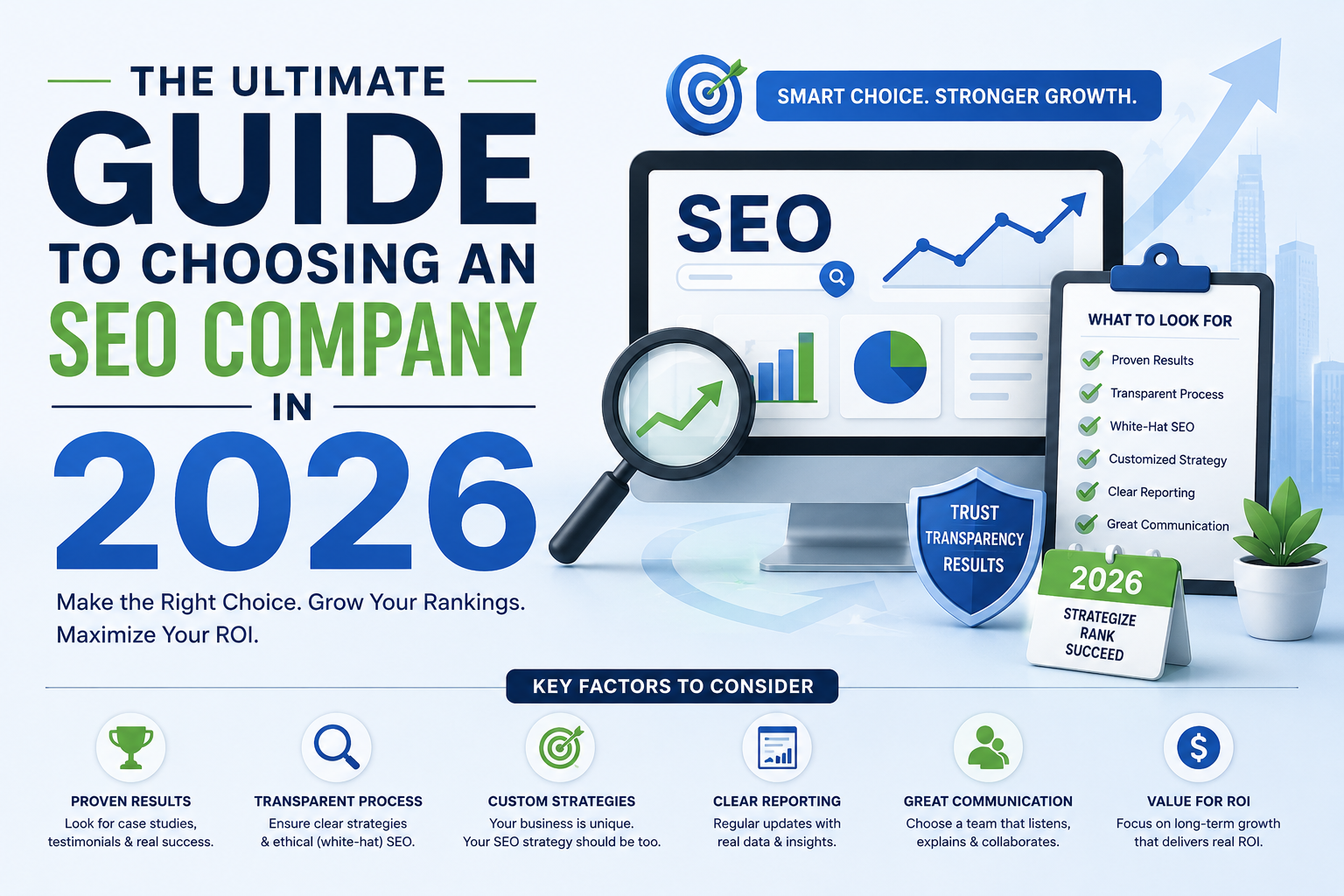
Hiring an SEO company is one of the highest-leverage marketing decisions a business can make — and one of the easiest to get wrong. The industry has a low barrier to entry, which means alongside genuinely skilled agencies, there’s no shortage of outfits selling vague promises, recycled strategies, or backlinks from low-quality guest-post networks. In 2026, with search engines leaning harder on AI-driven ranking signals and E-E-A-T (Experience, Expertise, Authoritativeness, Trustworthiness), the gap between agencies that actually move the needle and ones that don’t has only widened.
This guide walks through how to evaluate an SEO company, what red flags to watch for, and a couple of smaller agencies worth knowing about if you’re comparing options.
Why SEO Still Matters in 2026
Organic search remains one of the highest-ROI acquisition channels for most businesses, because it captures people who are already looking for what you offer. But the playbook has changed:
- AI-powered search results (from Google’s AI Overviews to other AI-assisted search experiences) now summarize answers directly, so ranking for informational queries requires deeper topical authority, not just keyword matching.
- Core Web Vitals and technical performance carry more weight — a slow or poorly structured site can undercut even great content.
- E-E-A-T means search engines increasingly reward content that demonstrates real experience and credible authorship, not generic filler.
- Local and niche relevance matter more as generic, broad-match SEO gets outcompeted by agencies who understand a specific industry or region.
An agency that’s still selling you a 2020-style playbook — quantity-over-quality backlinks, thin content, exact-match keyword stuffing — is going to waste your budget or, worse, get your site penalized.
How to Vet an SEO Company Before You Sign a Contract
1. Ask for real, verifiable case studies
A credible agency can show you specific before/after ranking or traffic data, ideally with a named client or a redacted-but-detailed example. Be wary of agencies that only offer vague testimonials (“Our SEO services help increase your website’s visibility”) with no numbers attached.
2. Check for a real team and real location
Look for an actual “About” or team page with named people, LinkedIn profiles, or a verifiable business address. A one-page site with a contact form and no discoverable staff is a signal to dig deeper.
3. Get clarity on their link-building methods
Ask directly: where do backlinks come from? Legitimate agencies build links through outreach, digital PR, and genuine relationships with relevant publishers. Be cautious of agencies that are vague about this or that seem to primarily run their own network of blogs to sell links from.
4. Watch for keyword-stuffed or templated content
If an agency’s own website repeats an oddly specific phrase dozens of times across near-identical pages (e.g., the same exact keyword phrase copy-pasted into pages that claim to serve completely different countries), that’s a sign the site is built to game search rankings rather than serve real clients — and it tells you something about the tactics they’d likely apply to your site, too.
5. Ask what they measure and how they report
Rankings alone are a vanity metric. A good agency reports on organic traffic, conversions, and revenue impact, and explains their methodology in plain language.
6. Understand pricing and contract terms
Reasonable SEO retainers involve real scope: research, content, technical audits, and reporting. Be skeptical of prices that seem too low for the promised results, and read the contract for lock-in periods and ownership of the work (do you keep the content and links if you leave?).
7. Match expertise to your niche
Local SEO, e-commerce SEO, and enterprise SEO all require different skill sets. An agency that specializes in your type of business will typically outperform a generalist.
A Red Flag Worth Naming: “Agency-Style” Content Farms
One pattern worth knowing about as you research options: some websites are built to look like SEO agencies — complete with service pages, testimonials, and “About Us” copy — but function primarily as content or guest-posting platforms designed to rank for agency-related search terms, rather than as businesses that actually deliver client services. Common tells include:
- No pricing, no clear service packages, no consultation booking flow
- The same unusual keyword phrase repeated verbatim across many pages
- Multiple near-identical versions of the same site claiming to serve different countries (e.g., “leading agency in the USA” and “leading agency in Australia” with nearly identical copy)
- Testimonials with no attributable business names
- Blog content that reads as generic and interchangeable across topics
If you come across a site like this while comparing SEO providers, it’s worth treating it as a guest-post/content platform rather than a vendor to hire.
Two Agencies Worth Knowing About
If you’re building a shortlist, here are two smaller agencies in the SEO and outreach space:
MWT Media Founded in 2019, MWT Media is a digital marketing agency offering SEO, content writing, guest posting, PPC, and social media services, with a stated focus on the U.S. market alongside broader international work. Their services span on-page optimization, link building, technical SEO, and local SEO for businesses looking to improve regional visibility. As with any agency at this scale, ask for specific case studies and clarify their link-building sources before committing to a retainer.
Digi Global Media Digi Global Media positions itself around SEO, local SEO, and guest-posting services aimed at improving search visibility for client sites. As a smaller player, it’s worth the same diligence: request examples of past results, ask how backlinks are sourced, and confirm reporting cadence before signing on.
Neither of these should be treated as a “top pick” without you doing your own diligence — they’re names that come up in the small-to-mid agency space, not a substitute for checking references and case studies specific to your industry and budget.
Final Checklist Before You Hire
- They can show verifiable, specific results (not just testimonials)
- Their own site doesn’t show signs of keyword-stuffing or templated multi-country cloning
- They’re transparent about link-building and content sourcing
- Reporting goes beyond rankings to traffic and conversions
- Contract terms are clear on ownership, cancellation, and scope
- Their specialty matches your business type (local, e-commerce, enterprise, etc.)
Choosing the right SEO partner in 2026 comes down to the same fundamentals it always has: transparency, proof of results, and a strategy built around genuine value to users — not shortcuts designed to game the algorithm.

Daniel
Daniel Addam is an SEO & Content Writer at MWT Media, specialising in crafting data-driven content that ranks. With a deep understanding of search engine optimisation, keyword strategy, and audience engagement, Daniel creates compelling articles, blog posts, and web copy that not only attract organic traffic but convert readers into customers. At MWT Media, Daniel plays a key role in developing content strategies that align with client goals — from on-page SEO optimisation to high-quality guest posting campaigns. His work is rooted in research, precision, and a commitment to delivering measurable results. When it comes to digital content, Daniel believes that great writing and smart SEO are not mutually exclusive — and his work at MWT Media reflects exactly that.