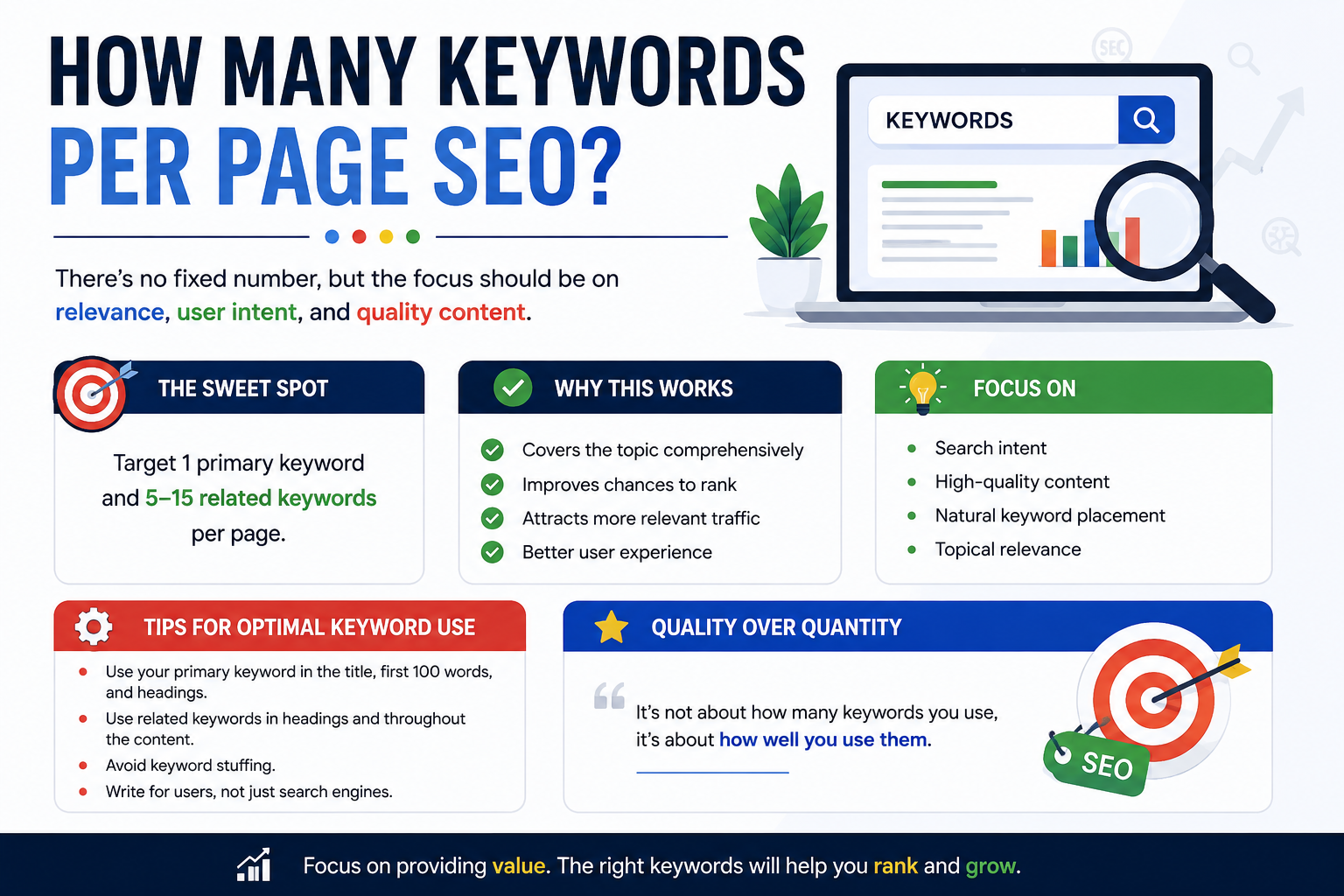
If you’ve ever sat staring at a blank content brief wondering how many keywords per page SEO actually requires, you’re not alone. It’s one of the most searched questions in content marketing — and one of the most misunderstood.
The short answer: there’s no magic number. The longer, more useful answer is what this article is about.
Why “How Many Keywords Per Page” Is the Wrong Question
A decade ago, keyword density mattered. Stuff a page with a target phrase enough times and search engines would reward you for it. That era is over.
Today’s search algorithms are built around natural language understanding. They read content the way a person does — looking for context, relevance, and intent — not counting how many times a phrase appears. So when people ask how many keywords per page SEO experts recommend, the honest response is: focus less on quantity and more on structure.
So What’s a Practical Framework?
Even without a hard rule, most experienced SEOs work within a loose structure that looks like this:
1. One primary keyword per page This is the main phrase you want the page to rank for. It should appear in your title tag, H1, URL, and naturally within the first 100 words.
2. 3–5 secondary keywords These are closely related terms and variations searchers might use instead of your primary keyword. They reinforce topical relevance without repeating the same phrase over and over.
3. 5–10 supporting or long-tail phrases These appear naturally throughout the body content as you explain, expand, and answer related questions. They’re not “targeted” so much as a natural byproduct of writing thoroughly on a topic.
If you’re wondering how many keywords per page SEO tools like to see, most on-page checkers flag anything with a keyword density above 2–3% as excessive. But density scores are a rough guide, not a ranking factor — Google doesn’t score-check the way older tools imply.
What Matters More Than Keyword Count
Search intent match. A page can hit every keyword target and still fail if it doesn’t answer what the searcher actually wants.
Topical depth. Covering a subject thoroughly — related questions, context, examples — naturally brings in dozens of relevant terms without deliberate keyword placement.
Readability. If a human reader would notice repetition, an algorithm will too. Write for people first.
Internal linking and site structure. Instead of cramming multiple keyword variations onto one page, dedicate separate pages to closely related terms and link between them. This is often a better strategy than trying to rank one page for everything.
A Simple Test: Would You Say It Out Loud?
Here’s a quick sanity check. Read your paragraph aloud. If a keyword phrase sounds unnatural or repetitive when spoken, it’s probably unnatural to a search engine too. Good keyword usage should be invisible — readers shouldn’t notice it’s there.
Common Mistakes to Avoid
- Keyword stuffing. Repeating the exact phrase excessively still triggers spam signals in some algorithms and reads poorly to users.
- Targeting too many keywords on one page. Spreading a single page across five unrelated keyword themes dilutes relevance for all of them.
- Ignoring keyword variations. Sticking rigidly to one exact phrase (instead of natural variations) can make content feel robotic and limits how many related searches you can rank for.
- Chasing volume over intent. A high-search-volume keyword with the wrong intent behind it won’t convert, no matter how well-optimized the page is.
Final Answer: How Many Keywords Per Page?
If you need a number to work with: aim for 1 primary keyword, a handful of secondary variations, and natural long-tail coverage throughout. But the real goal isn’t hitting a count — it’s writing a page so relevant and thorough that it naturally contains the language your audience is searching for.
That’s the real answer to how many keywords per page SEO success actually depends on: fewer forced keywords, more genuine topical authority.