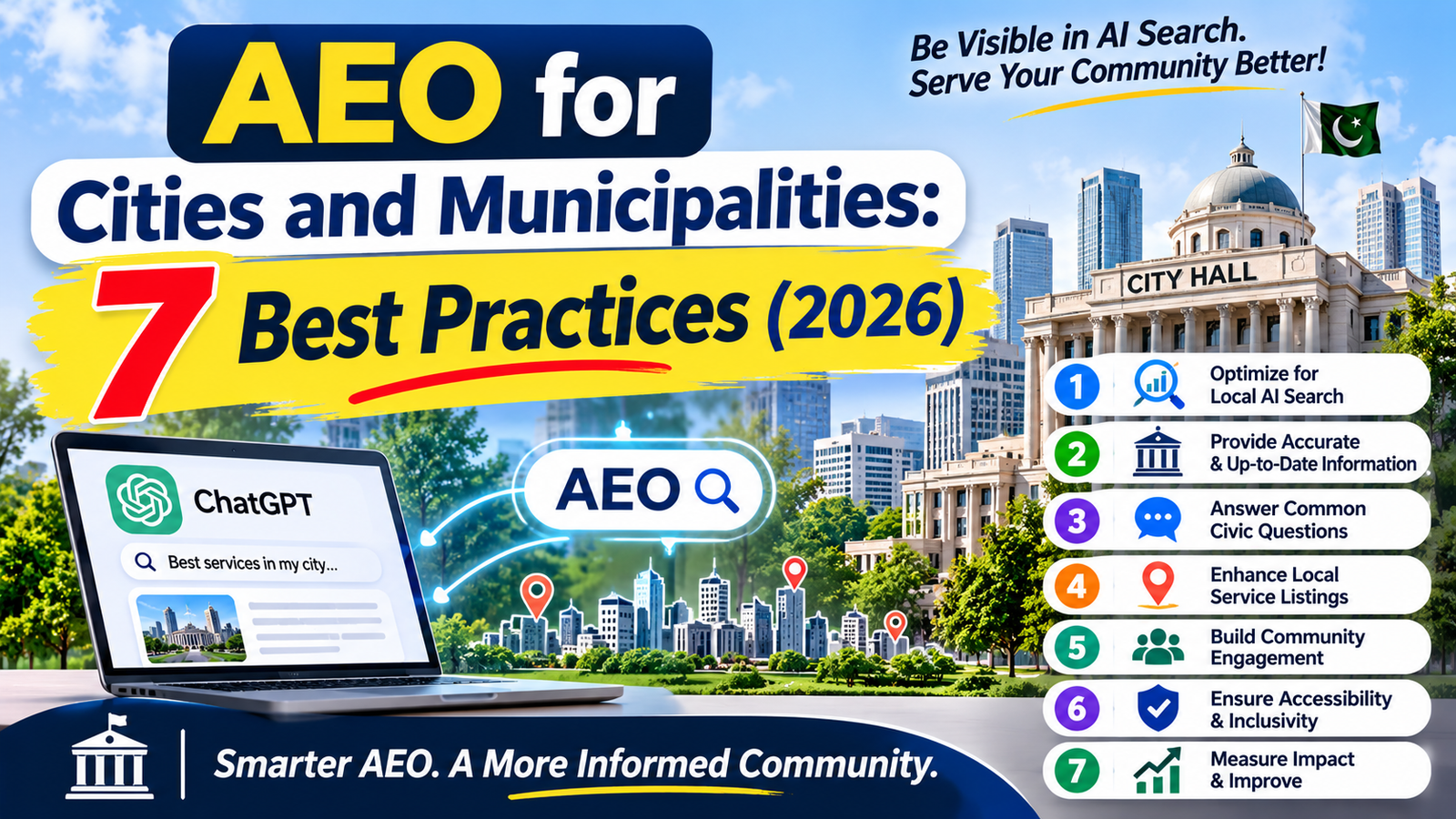
When residents want to know how to renew a parking permit, when trash pickup changes for a holiday, or where to pay a utility bill, many no longer open a search engine and scroll through links. They ask ChatGPT, Google’s AI Overviews, Perplexity, or a voice assistant, and they trust the answer they get.
That makes AEO for cities and municipalities a serious priority. If an AI system gives a resident outdated fees or the wrong office hours, the result is frustrated residents, extra calls to city staff, and lost trust. In this guide, MWT Media explains what Answer Engine Optimization means for local government and shares seven best practices you can start using today.
What Is AEO and Why Does It Matter for Local Government?
Answer Engine Optimization (AEO) is the practice of structuring your content so AI-powered answer engines can find it, understand it, and present it accurately. Traditional SEO aims to get your pages ranked in a list of links. AEO aims to make your content the source of the answer itself.
Cities and municipalities have a unique advantage here. They are the official source for most of the information residents need, including permits, taxes, zoning, public meetings, emergency alerts, and local services. But that advantage only counts if AI systems can easily read, trust, and quote your content.
Here is why AEO for cities and municipalities deserves attention now:
- Residents ask questions in natural language. They type or speak full questions rather than short keywords.
- AI answers often skip the click. If your content isn’t structured well, the AI may pull from a third-party site instead.
- Accuracy is a public service issue. Wrong information about deadlines, fees, or emergency procedures can cause real problems.
- Staff time is limited. Clear answers online reduce repetitive phone calls and emails.
7 Best Practices for AEO for Cities and Municipalities
1. Build Question-Led Service Pages
Organize your website around the questions residents actually ask. Instead of a vague page titled “Public Works Division,” create pages such as:
- How do I report a pothole?
- How do I apply for a building permit?
- When is bulk trash pickup?
- How do I pay my water bill online?
Put the question in a heading, then give the direct answer in the first one or two sentences. Follow with details, steps, fees, and links. AI systems favor content that answers a question quickly and clearly, and residents appreciate it too.
Tip: Review your call logs, email inbox, and social media comments to find the most common questions. Those are your best page topics.
2. Write in Plain Language
Government writing is often full of legal wording and internal jargon. AI models and residents both struggle with it. Aim for short sentences, everyday words, and a reading level most people find easy.
- Replace “remit payment” with “pay.”
- Replace “pursuant to Ordinance 14-22” with a simple explanation, then link to the ordinance for those who need it.
- Spell out acronyms the first time you use them.
Plain language improves accuracy because there is less room for an AI to misinterpret what you mean.
3. Use Structured Data (Schema Markup)
Schema markup is code that tells search engines and AI systems exactly what a page contains. For local government websites, useful types include:
- GovernmentOrganization or GovernmentOffice for departments and offices
- FAQPage for question-and-answer content
- Event for council meetings, public hearings, and community events
- Service for permits, licenses, and utility services
- BreadcrumbList to clarify site structure
Structured data removes guesswork. Instead of hoping an AI works out your office hours, you state them in a format machines can read directly.
4. Keep Your Business Information Consistent Everywhere
AI systems pull information from many places, including your website, Google Business Profile, Apple Maps, Bing Places, social profiles, and local directories. If your City Hall address, phone number, or hours differ across these sources, the AI may repeat the wrong version.
Do a regular audit of:
- Department names, addresses, and phone numbers
- Office hours, including holiday closures
- Official website links
- Social media profile details
Claim and verify your listings on major platforms, and update them all whenever something changes.
5. Keep Content Fresh and Show Update Dates
Outdated information is one of the biggest risks in AEO for cities and municipalities. Fee schedules change, offices move, and programs end. If an old page still ranks, an AI may quote it.
- Add a visible “Last updated” date to service pages.
- Review high-traffic pages on a set schedule, such as quarterly.
- Redirect or remove obsolete pages instead of leaving them online.
- Clearly label archived content.
Freshness signals help both AI systems and residents trust that what they read is current.
6. Make Documents and Data Accessible and Crawlable
Many municipal websites hide important information inside scanned PDFs, meeting minutes, and image-based forms. AI systems often cannot read these well, and neither can screen readers.
- Publish key information as regular web pages, not only as PDFs.
- Use text-based PDFs rather than scans, with proper headings.
- Add descriptive alt text to images.
- Follow accessibility standards such as WCAG, which benefits all users and improves machine readability.
- Give meeting agendas and summaries their own pages with clear titles and dates.
Accessible content is easier for AI to understand, and it fulfills your duty to serve every resident.
7. Monitor AI Answers and Fix Inaccuracies
You can’t improve what you don’t measure. Regularly test how AI platforms answer questions about your city. Ask ChatGPT, Gemini, Perplexity, and Google’s AI features the questions your residents would ask, such as:
- “How do I get a residential parking permit in [City]?”
- “What time does [City] Hall close?”
- “Who do I call to report a streetlight outage in [City]?”
Record the answers, note any mistakes, and trace them back to the source. Often the fix is updating a page, correcting a directory listing, or publishing a clearer answer. Repeat this check monthly and track your progress over time.
Common Mistakes to Avoid
- Burying answers in long pages. Lead with the answer, then add detail.
- Ignoring third-party listings. AI systems frequently rely on outside directories.
- Leaving old pages live. Outdated content can overshadow your current information.
- Treating AEO as a one-time project. Information changes, so your content must change with it.
- Neglecting mobile experience. Many residents search from their phones, so pages must load quickly and read well on small screens.
How MWT Media Can Help
Applying AEO for cities and municipalities takes content strategy, technical SEO, and steady maintenance. MWT Media offers SEO services including on-page, technical, and off-page optimization, plus keyword research, content marketing, and website audits. We can help you restructure service pages, improve your site’s technical foundation, and build the authority signals that make AI systems trust your content. We also offer a free basic website audit to show you where your site stands today.
Final Thoughts
Residents expect fast, accurate answers, and increasingly they get them from AI. By building question-led pages, using plain language, adding structured data, keeping listings consistent, updating content regularly, making documents accessible, and monitoring AI answers, your municipality can make sure those answers come from your official information.
AEO for cities and municipalities is not about chasing trends. It is about making public information easy to find and easy to trust. Start with your most-visited service pages, and build from there.
Want help getting your city’s information seen and trusted in AI search? Contact MWT Media today and let’s build a plan that works for your community.