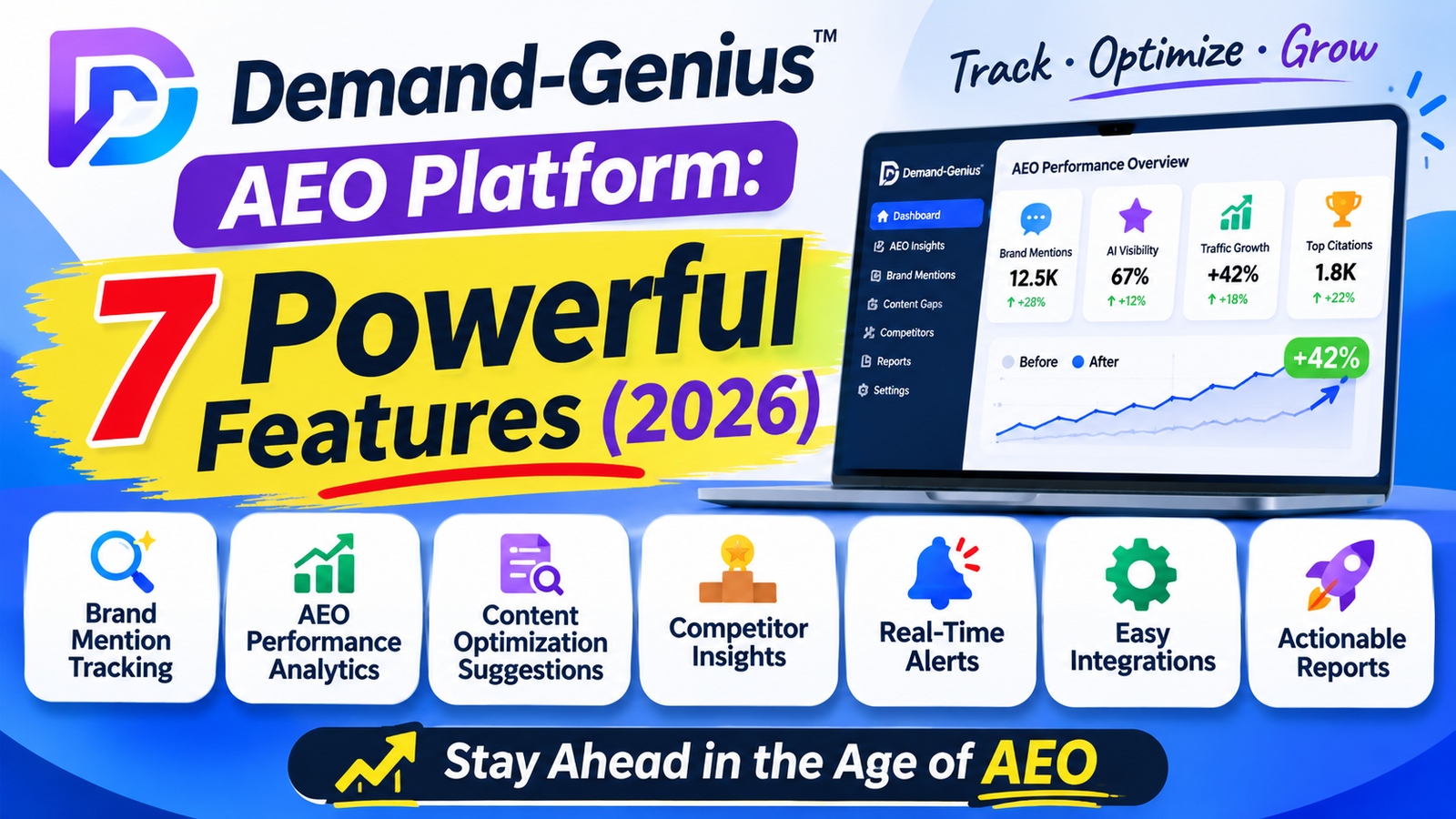
Buyers no longer start every purchase decision with a Google search. They ask AI assistants to explain a problem, compare vendors, and shortlist solutions, often before they visit a single website. That shift has created a new category of software, and the Demand-Genius AEO platform is one of the newer names in it.
In this guide, MWT Media looks at what Demand-Genius does, who it is built for, and the seven features that set it apart. We also cover how to decide whether it fits your marketing stack.
What Is the Demand-Genius AEO Platform?
Answer Engine Optimization (AEO) is the practice of making your brand visible, accurate, and trusted inside AI-generated answers. Demand-Genius is an AEO platform made for B2B companies. It aims to measure and influence how AI systems describe your brand in the “Dark AI” conversations where buying decisions form. partnerfleet
The product has changed a lot since its start. Demand-Genius launched in late 2024, and the team says the platform today looks very different from how it did eighteen months ago, having moved from a content attribution tool to an AEO optimisation platform. That history explains why it focuses on how AI perceives a brand rather than only counting citations. demand-genius
Why the Demand-Genius AEO Platform Is Getting Attention
Most AEO tools concentrate on what you can see: citations, referrals, and clicks. Demand-Genius argues that this covers only about 16% of buyer prompts, the part that generates clicks. The rest happens out of sight. According to the company, 84% of prompts in B2B journeys don’t cite any brand. g2demand-genius
If that figure holds for your market, a large share of the conversations shaping your category happen without a link to your site. A platform that tracks only citations would miss them.
7 Powerful Features of the Demand-Genius AEO Platform
1. Dark AI Conversation Tracking
The headline feature is tracking the invisible conversations where buyers explore problems and compare options. Demand-Genius positions itself as a way to win influence in the other 84%, the AI conversations where buyers define their requirements before they ever visit a company’s site. softwareadvice
For marketers, this means seeing how your brand is discussed even when no click or citation follows.
2. Narrative and Sentiment Monitoring
Being mentioned is only half the story. What the AI says about you matters just as much. The platform tracks narrative and sentiment, so you can see how your brand is framed. capterra
A neutral or negative description in an AI answer can quietly cost you deals. Monitoring sentiment lets you spot problems early and adjust your messaging.
3. LLM Perception and Positioning Analysis
Demand-Genius tracks how major large language models perceive your positioning. This helps you answer questions such as: capterra
- Does the AI understand what your product actually does?
- Which category does it place you in?
- Which strengths and weaknesses does it associate with your brand?
If the model’s picture of your company is wrong, you know exactly what your content needs to correct.
4. Intent Clustering
Buyers ask the same thing in many different ways. The platform clusters related intents so you can view them as themes instead of scattered prompts. That makes reporting simpler and helps your content team prioritize the topics that matter most to your pipeline. capterra
5. Competitor Monitoring
AI answers are rarely about one brand alone. Demand-Genius monitors competitors as well, so you can see who appears next to you, who appears instead of you, and how the AI compares the options. This turns visibility data into competitive intelligence. capterra
6. Content Intelligence and Auditing
Tracking is useful, but you also need to know what to fix. The platform audits content for the clarity and consistency that builds AI confidence. It also connects content intelligence with LLM perception in one platform, so your team can link what you publish to how AI systems describe you. capterracapterra
Consistent messaging across your website, blog, and third-party profiles makes it easier for AI models to describe you correctly.
7. AI Agents on an Open Framework
The platform runs on an open agent framework, which the company says helps it pivot quickly as the AEO landscape changes, and it highlights three agents for users. Given how fast AI search is evolving, flexibility like this is a practical advantage. A tool that can adapt quickly is less likely to be outdated in a year. demand-genius
Who Is the Demand-Genius AEO Platform Built For?
This is not a one-size-fits-all tool. Demand-Genius is designed for complex B2B buying journeys with long sales cycles, multi-stakeholder committees, and large content footprints. It is a strong match for: getapp
- B2B SaaS and technology companies
- Marketing teams with large content libraries
- SEO and AEO specialists who want more than citation counts
- Agencies managing visibility for B2B clients
The company also says it builds its tracking around original research into how AI behaves in B2B journeys, and it lists hundreds of B2B revenue teams as users. If you run a local service business or an online store, a simpler visibility tracker may serve you better. demand-genius
Pricing and Getting Started
Pricing is not published openly. Review sites list it as available upon request, so you will need to contact the vendor for a quote. Ask about the number of tracked prompts, the AI platforms covered, reporting options, and onboarding support. softwareadvice
How to Decide If It Is Right for You
Before you commit to any AEO platform, ask yourself:
- Is your audience B2B? Demand-Genius is built for longer, committee-driven sales.
- Do you need more than citation counts? If you want sentiment and perception data, it deserves a look.
- Can your team act on the insights? Data only helps if someone updates content and builds authority.
- Have you compared alternatives? Run a trial or demo with two or three tools using the same prompts.
How MWT Media Can Help
A tool shows you the problem, but it does not fix it. At MWT Media, we help brands improve their AI visibility through SEO services, content marketing, and high-authority guest posting and link building. Whatever platform you choose, we can help you turn the findings into content and authority signals that move the needle. We also offer a free basic website audit to show where your brand stands today.
Final Thoughts
The Demand-Genius AEO platform takes a different approach from citation-focused tools by concentrating on how AI systems perceive and describe your brand. With Dark AI tracking, sentiment monitoring, intent clustering, competitor analysis, content auditing, and an agent-based framework, it is aimed squarely at B2B teams with complex buying journeys.
As AI search keeps growing, brands that understand and shape their AI narrative will have an edge. Ready to strengthen your presence in AI answers? Contact MWT Media today and let’s build a strategy that gets your brand recommended.