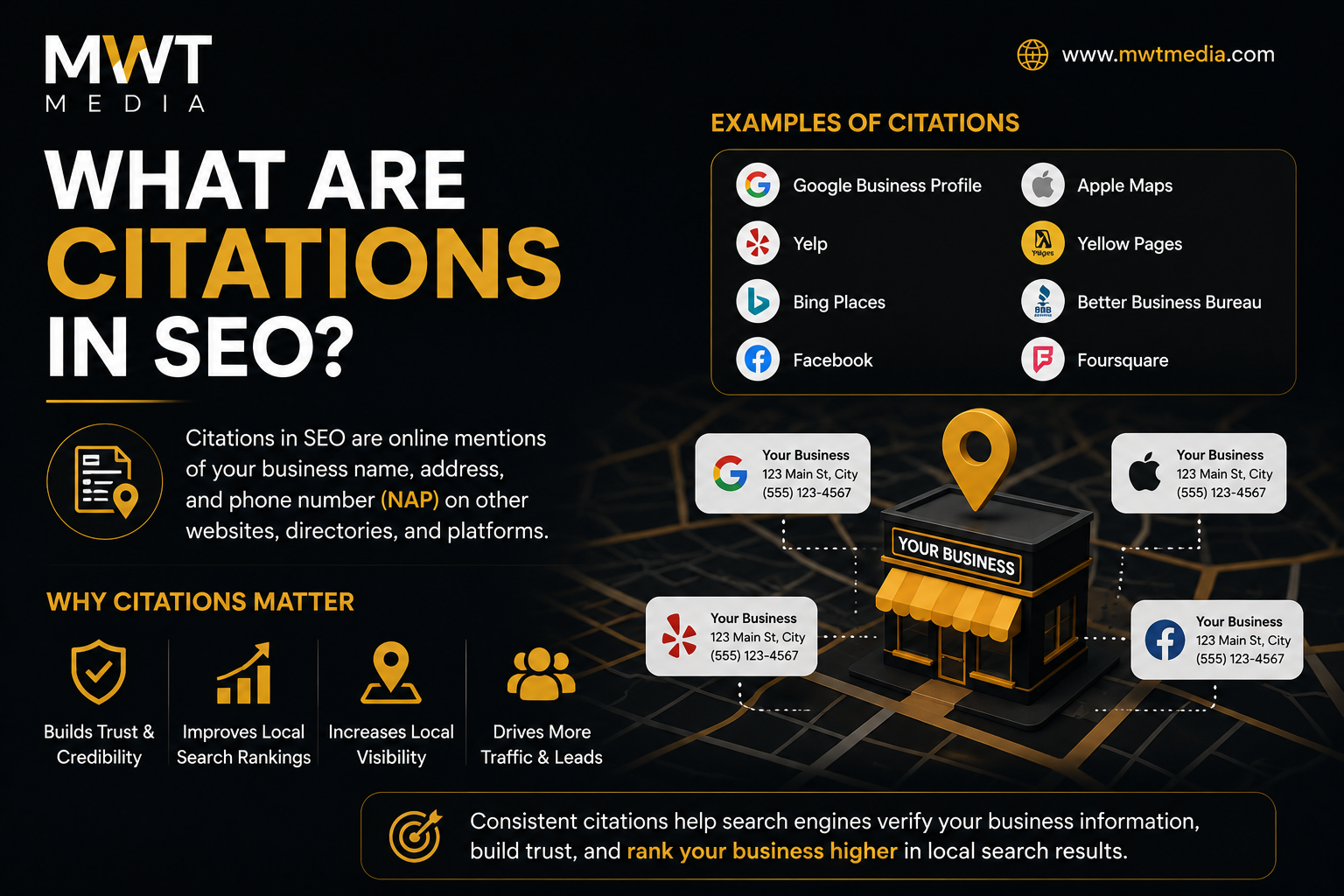
If you’ve been researching local SEO, you’ve probably run into the term “citations” more than once — but what are citations in SEO, exactly, and why do so many local SEO guides treat them as essential? In this article, we’ll break down exactly what citations are, why they matter, and share seven rules for building ones that actually help you rank.
What Are Citations in SEO?
A citation, in SEO terms, is any online mention of your business’s Name, Address, and Phone number (commonly abbreviated as NAP), typically found on directories, review sites, social platforms, and other websites — even if there’s no link back to your site.
So, what are citations in SEO in practical terms? They’re digital references to your business that help search engines verify your business is real, active, and located where you say it is. Think of platforms like Yelp, Yellow Pages, industry directories, and chamber of commerce websites — every time your business details appear there, that’s a citation.
Citations come in two main forms:
- Structured citations — business listings on directories like Google Business Profile, Yelp, Bing Places, and Apple Maps, where your NAP data is entered into defined fields.
- Unstructured citations — mentions of your business in blog posts, news articles, or social media posts, where your name, address, or phone number appears within regular text rather than a structured listing.
Why Citations Matter for SEO
Citations aren’t just a formality — they play a real role in how search engines evaluate your business, especially for local search results.
1. They Build Trust and Verification
- When your business information appears consistently across many reputable sites, search engines gain more confidence that your business is legitimate, active, and accurately represented. This consistency is one of the clearest ways citations support local rankings.
2. They Support the Local Pack Algorithm
- Google’s local ranking system relies heavily on three factors: relevance, distance, and prominence. Citations directly feed into prominence — the more consistently your business appears across trusted directories, the more “prominent” and established it appears to Google’s algorithm.
3. They Improve Discoverability
- Citations don’t just help with Google. Many people search directly on platforms like Yelp, Apple Maps, or industry-specific directories rather than Google itself, so having accurate, complete listings helps customers find you across multiple channels — not just search engines.
4. They Reinforce Local Relevance
- Citations on location-specific or industry-specific directories (a local chamber of commerce site, or an industry association directory) send additional relevance signals tied to both your geography and your business category.
7 Rules for Building Citations That Actually Help You Rank
Rule #1: Keep Your NAP Information 100% Consistent
- This is the single most important rule. Your business name, address, and phone number should appear identically across every citation — down to formatting details like “St.” vs. “Street” or “Suite 200” vs. “#200.” Inconsistent NAP data confuses search engines and can weaken the trust signal citations are supposed to build.
Rule #2: Prioritize High-Authority, Relevant Directories
- Not all citations carry equal weight. Focus first on major, trusted platforms — Google Business Profile, Bing Places, Apple Maps, Yelp, and Facebook — before moving on to smaller or niche directories. Quality and relevance matter more than sheer volume.
Rule #3: Claim and Verify Every Listing
- An unclaimed listing is a missed opportunity and a potential risk, since incorrect information can sit unmanaged indefinitely. Always claim and verify your business listings so you control what information is displayed and can update it when needed.
Rule #4: Target Industry-Specific and Local Directories
- Beyond the major platforms, look for directories specific to your industry (like Avvo for lawyers or Healthgrades for medical providers) and your local area (chamber of commerce sites, local business associations). These niche citations often carry more targeted relevance than generic, low-authority directories.
Rule #5: Regularly Audit for Duplicate or Outdated Listings
- Old addresses, disconnected phone numbers, or duplicate listings from a previous business name can all hurt the consistency search engines rely on. Periodically audit your citations, especially after a move, rebrand, or phone number change, and correct or remove anything outdated.
Rule #6: Add Complete, Rich Information Where Possible
- Whenever a directory allows it, fill out your listing fully — hours of operation, categories, photos, website link, and a business description. Complete listings tend to perform better both in terms of user engagement and platform-level visibility.
Rule #7: Don’t Neglect Unstructured Citations
- While structured directory listings are the foundation, unstructured mentions (a local news article referencing your business, a blog post recommending your services) add additional credibility. Building relationships with local media, bloggers, and industry publications can naturally generate these mentions over time.
Common Citation Mistakes to Avoid
- Inconsistent formatting across listings (abbreviations, suite numbers, punctuation).
- Outdated information left unmanaged after a business move or rebrand.
- Duplicate listings competing against each other for the same business.
- Ignoring niche or local directories in favor of only major platforms.
- Leaving listings incomplete, missing out on additional visibility and trust signals.
Citations vs. Backlinks: What’s the Difference?
It’s easy to confuse citations with backlinks, but they serve different purposes. A backlink is a hyperlink from another website pointing to yours, primarily valued for passing authority. A citation, on the other hand, doesn’t need to include a link at all — its value comes from the consistency and presence of your business information across the web, particularly for local SEO. Ideally, you want both: citations to build local trust and prominence, and backlinks to build overall domain authority.
So, What Are Citations in SEO? The Quick Recap
To summarize: what are citations in SEO? They’re consistent mentions of your business’s name, address, and phone number across directories, review platforms, and other websites — a foundational element of local SEO that builds trust, prominence, and discoverability. While they may seem like a small, administrative task, consistent and well-managed citations remain one of the most reliable ways to strengthen your local search visibility.
At MWT Media, citation building and auditing is a core part of every local SEO strategy we run, because the businesses that rank consistently in local search are almost always the ones with clean, consistent, and complete citation profiles.