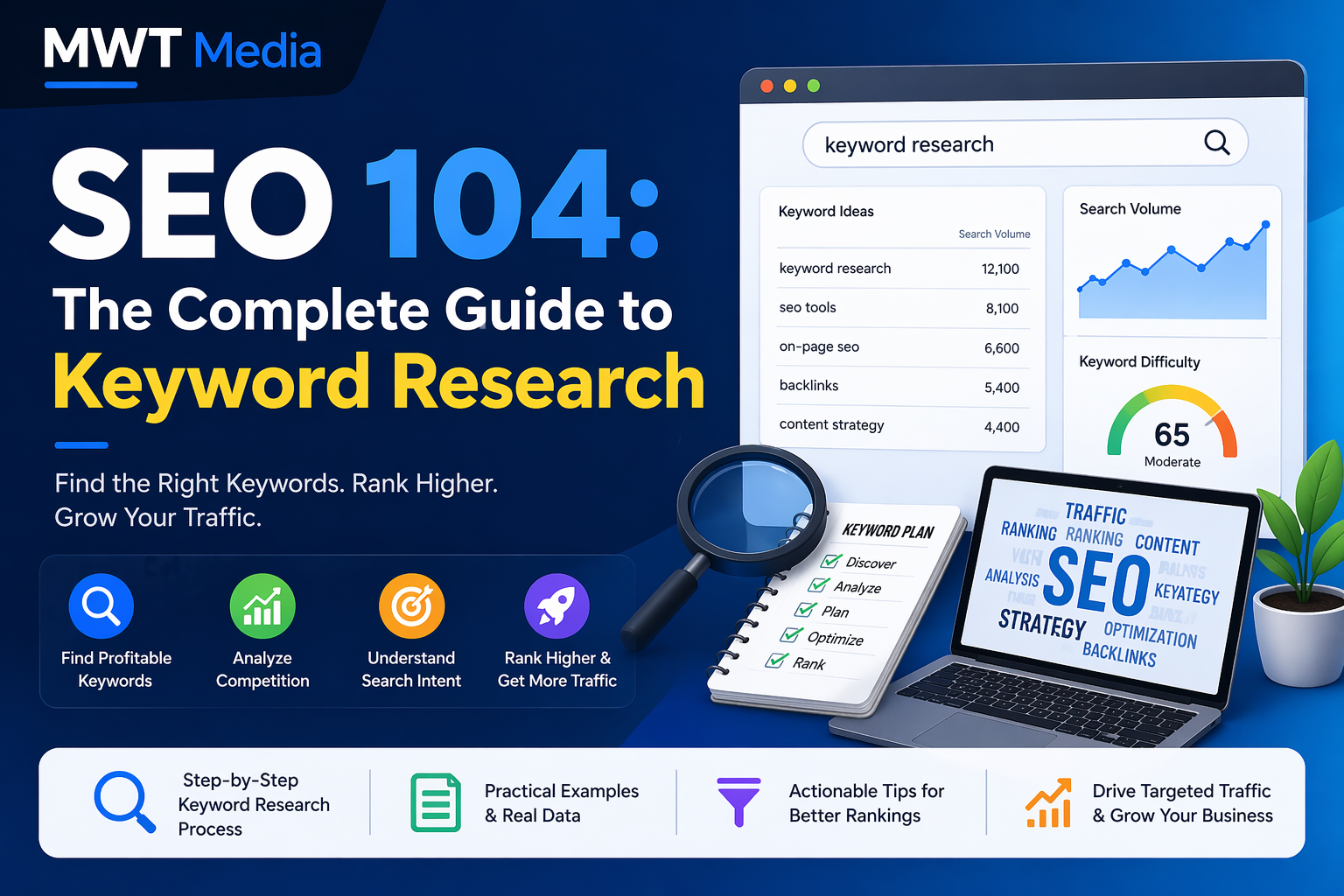
If you have already worked through the fundamentals of search engine optimisation and understand how content, links, and technical structure play their roles, you are ready for the next level. SEO 104 is where strategy gets serious — and keyword research sits at the very heart of it. This is not about guessing what people search for. It is about understanding human intent, mapping it to your content, and building a sustainable foundation for organic visibility.
What Is Keyword Research and Why Does It Matter?
Keyword research is the process of discovering and analysing the actual words and phrases that people type into search engines when looking for information, products, or services. It is the compass of any well-executed SEO strategy.
Without keyword research, content creation is little more than guesswork. You might write brilliantly and still reach nobody, simply because you chose words that no one is searching for — or words so competitive that ranking for them is practically impossible. SEO 104 addresses this gap by giving you a repeatable, data-driven system for choosing the right keywords at the right time.
The payoff is significant. Done well, keyword research tells you:
- What your audience actually wants — not what you assume they want
- How much competition you face for any given search term
- Where the real opportunities lie — high-value, lower-competition gaps your competitors have missed
- How to structure your entire content strategy around real demand
Core Concepts You Must Understand First
Before diving into tools and tactics, SEO 104 demands a firm grasp of three foundational concepts.
1. Search Intent
Every keyword carries an intent behind it. There are four primary types:
- Informational — the user wants to learn something (e.g., “how does photosynthesis work”)
- Navigational — the user wants to find a specific website (e.g., “Facebook login”)
- Commercial — the user is researching before making a purchase (e.g., “best running shoes 2026”)
- Transactional — the user is ready to act (e.g., “buy Nike Air Max online”)
Matching your content type to the correct search intent is one of the most critical skills taught in SEO 104. A product page optimised for an informational keyword will rarely rank well — because Google understands what the searcher actually wants and serves content accordingly.
2. Search Volume
Search volume tells you how many times a keyword is searched per month on average. High-volume keywords attract more traffic but are typically more competitive. Low-volume keywords may seem unattractive but often convert better because they are more specific.
3. Keyword Difficulty
Keyword difficulty (KD) is a score — usually from 0 to 100 — that estimates how hard it would be to rank on the first page of Google for a given keyword. New or lower-authority websites should generally target keywords with a KD below 30. Established sites can compete for harder terms.
Types of Keywords
A complete SEO 104 keyword strategy involves multiple keyword types working together.
Short-Tail Keywords
These are broad, one- to two-word terms such as “shoes” or “SEO guide.” They carry enormous search volume but are highly competitive and often vague in intent. Ranking for them takes significant authority and time.
Long-Tail Keywords
Long-tail keywords are longer, more specific phrases — typically three or more words — such as “best running shoes for flat feet” or “keyword research guide for beginners.” They have lower individual search volumes but collectively drive the majority of all search traffic. They also convert at higher rates because users searching with specificity usually know what they want.
In SEO 104, long-tail keywords are often your most valuable early targets. They are the gateway through which newer websites build traffic, credibility, and ranking momentum.
LSI Keywords (Latent Semantic Indexing)
LSI keywords are terms semantically related to your main keyword. They help search engines understand the full context of your content. If your primary keyword is “coffee brewing,” LSI terms might include “espresso,” “grind size,” “pour-over method,” and “water temperature.” Using them naturally improves topical depth.
Branded vs. Non-Branded Keywords
Branded keywords include your company or product name. Non-branded keywords are generic industry terms. Both matter — but non-branded terms are where new audiences discover you.
The Keyword Research Process: Step by Step
This is the practical engine of SEO 104. Follow this process methodically and you will build a keyword library that fuels your content strategy for months.
Step 1 — Define Your Niche and Audience
Before opening any tool, get specific. Who are you writing for? What problems do they have? What language do they use? A keyword that sounds natural to an expert might be completely foreign to a beginner in the same field. Your audience’s vocabulary is your starting point.
Step 2 — Brainstorm Seed Keywords
Seed keywords are the broad, foundational terms that describe your topic. If you run a personal finance blog, your seed keywords might include “budgeting,” “saving money,” “investing,” and “credit score.” These are not your final targets — they are the seeds from which your full keyword list will grow.
Step 3 — Use Keyword Research Tools
This is where SEO 104 gets truly powerful. Several tools allow you to expand your seed keywords into hundreds of variations, complete with search volume, difficulty scores, and related terms.
Top tools to know:
- Google Keyword Planner — Free, directly from Google, ideal for understanding search volume ranges and discovering related terms.
- Ahrefs Keywords Explorer — One of the most comprehensive paid tools, offering keyword difficulty, traffic potential, and SERP analysis.
- SEMrush — Excellent for competitor keyword analysis and gap identification.
- Ubersuggest — A more accessible paid option with a limited free tier, well suited for smaller budgets.
- AnswerThePublic — Generates question-based keywords, ideal for informational content and voice search optimisation.
- Google Search Console — Once your site has traffic, this free tool shows you the exact queries bringing people to your site.
Step 4 — Analyse the SERP
Never commit to a keyword without first studying the Search Engine Results Page (SERP) for that term. Ask yourself:
- What types of content rank on page one — blog posts, product pages, videos, or tools?
- How authoritative are the ranking sites?
- Are featured snippets, image packs, or People Also Ask boxes appearing?
- Is there a content gap you can fill better than existing results?
SERP analysis is one of the most underrated skills in SEO 104 and one of the most important.
Step 5 — Evaluate and Prioritise
Not all keywords belong in your strategy. Score and prioritise your list by weighing three factors:
- Relevance — How closely does this keyword align with your content and audience?
- Opportunity — Is the difficulty low enough for your current domain authority?
- Value — Does traffic from this keyword serve a business goal — lead generation, sales, brand awareness?
Build a simple spreadsheet. Assign scores. Focus on the terms with the best balance of all three.
Step 6 — Map Keywords to Content
Each piece of content should target one primary keyword and a cluster of supporting terms. This is called keyword mapping — assigning keywords to specific URLs so that no two pages compete against each other (a problem known as keyword cannibalisation).
A well-mapped site, as taught in SEO 104, functions like a well-organised library: every piece of content has its place, its purpose, and its designated search terms.
Competitive Keyword Gap Analysis
One of the most powerful techniques in SEO 104 is finding keywords your competitors rank for that you do not. Tools like Ahrefs and SEMrush offer a “Content Gap” or “Keyword Gap” feature that does exactly this — comparing your keyword profile against competitors and surfacing the opportunities you are missing.
This approach accelerates strategy significantly. Instead of building a keyword list from scratch, you are learning directly from what is already working in your niche — and identifying where you can do it better.
Common Keyword Research Mistakes to Avoid
Even experienced marketers make these errors. SEO 104 teaches you to recognise and correct them.
- Targeting only high-volume keywords — Volume means nothing if you cannot rank or convert. Balance ambition with realism.
- Ignoring search intent — A technically optimised page still fails if it serves the wrong intent.
- Keyword stuffing — Forcing a keyword into your content unnaturally damages readability and risks penalties. Context and flow matter.
- Neglecting long-tail terms — These are often where the highest-converting traffic lives.
- Set-and-forget research — Search behaviour evolves. Revisit your keyword strategy every three to six months.
Putting It All Together
Keyword research is not a one-time task. It is an ongoing practice — a dialogue between your content and your audience’s evolving needs. The techniques covered in SEO 104 give you not just a list of words to target, but a mindset: one of curiosity, precision, and continuous learning.
When you understand what people are searching for — and why — you stop creating content and start creating answers. You stop chasing rankings and start building authority. That is the transformation that separates mediocre SEO from the kind that compounds in value over time.
SEO 104 is not the end of your learning journey. It is the moment your strategy becomes intentional. Master keyword research, and every other element of SEO — your content, your links, your site structure — begins to align around a clear, data-backed purpose.

Daniel
Daniel Addam is an SEO & Content Writer at MWT Media, specialising in crafting data-driven content that ranks. With a deep understanding of search engine optimisation, keyword strategy, and audience engagement, Daniel creates compelling articles, blog posts, and web copy that not only attract organic traffic but convert readers into customers. At MWT Media, Daniel plays a key role in developing content strategies that align with client goals — from on-page SEO optimisation to high-quality guest posting campaigns. His work is rooted in research, precision, and a commitment to delivering measurable results. When it comes to digital content, Daniel believes that great writing and smart SEO are not mutually exclusive — and his work at MWT Media reflects exactly that.